How to Build an AI Agent Knowledge Base in GoHighLevel That Stops Wrong Answers (2026 Guide)
Last updated: October 2026.
An AI agent knowledge base in GoHighLevel is the single biggest factor in whether your Conversation AI or Voice AI agent gives a client's customers the right answer or confidently makes one up. Most agencies spend hours on the prompt and twenty minutes on the knowledge base, then wonder why the bot quotes last year's prices or promises a Saturday appointment that does not exist.
This guide shows Australian agency owners exactly how to collect, structure, test and maintain a knowledge base so your AI agents stay accurate after go-live, not just on demo day.
Some links below are affiliate links — if you sign up through them, Pivot 2 Thrive may earn a commission at no extra cost to you. It never changes what we recommend.
Key takeaway: A GoHighLevel AI agent is only as accurate as the knowledge base behind it. Build it from verified client sources, write it as short question-and-answer blocks with one fact per block, test it against 30 or more real customer questions before launch, and assign a named owner to update it monthly.
On This Page
- What an AI Agent Knowledge Base Is (and What It Isn't)
- Why Knowledge Base Accuracy Decides Whether Clients Stay
- How to Build a GoHighLevel Knowledge Base in 5 Steps
- Australian Example: The Bulk-Billing Answer That Wasn't
- 5 Knowledge Base Mistakes That Make AI Agents Guess
- Frequently Asked Questions
- Related Articles
This guide is written by Dr Priya Jaganathan, Go High Level Certified Admin, Certified AI Tech Stack Consultant and keynote speaker, who builds and audits AI automation systems for Australian businesses and agencies every week at Pivot 2 Thrive.
What an AI Agent Knowledge Base Is (and What It Isn't)
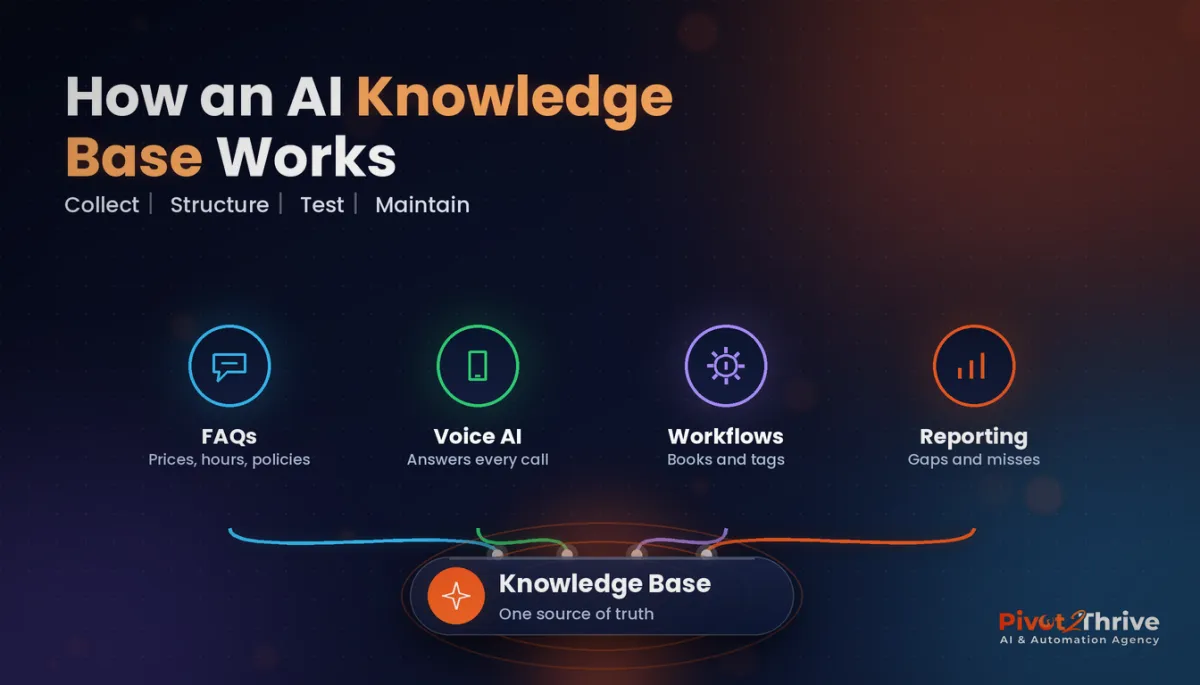
An AI agent knowledge base is the set of documents, FAQs, web pages and tables your AI agent searches before it answers a question. In GoHighLevel, you attach it to Conversation AI and Voice AI agents so they ground their replies in the client's real information instead of the model's general knowledge.
Think of the prompt as the agent's personality and rules, and the knowledge base as its memory of the business. The prompt says "be friendly, book appointments, never give medical advice". The knowledge base says "a standard clean is $189, we're closed public holidays, parking is behind the building".
When the two get mixed up, accuracy drops. Prices buried in a 2,000-word prompt are hard to update and easy for the model to blend together.
Why Knowledge Base Accuracy Decides Whether Clients Stay
Wrong answers are the fastest way to lose an AI client. A receptionist that misquotes a fee or books a service the business no longer offers creates refunds, complaints and a very uncomfortable monthly review.
The research backs the approach. Meta AI researchers Shuster et al., in their 2021 paper Retrieval Augmentation Reduces Hallucination in Conversation, found that grounding a chatbot in retrieved documents substantially reduced knowledge hallucination in human evaluations compared with the same models answering from memory alone.
In plain terms: a model that looks things up gets facts right more often than a model that guesses. But retrieval only helps if what it retrieves is correct, current and easy to find. That is the agency's job, and it is the part most builds skip.
If you have already had a bot go off-script, our guide on what to do when your AI agent gets it wrong covers the incident response. This post is about preventing it in the first place.
How to Build a GoHighLevel Knowledge Base in 5 Steps
Here is the five-step process we use at Pivot 2 Thrive on every AI receptionist and chat agent build. It slots in after discovery and before the delivery QA pass.
Step 1: Collect from verified sources only
Ask the client for the documents their best staff member actually uses: the current price list, service menu, booking policy, cancellation terms, service areas and the questions customers ask most.
Do not scrape the whole website and call it done. Websites are often out of date, and an old blog post about a discontinued service will be retrieved just as happily as the current price list. If a page is not current, it does not go in.
Step 2: Structure it as one fact per block
Rewrite the source material into short question-and-answer blocks. Each block answers one question in two to four sentences and repeats the key noun, so retrieval can match it.
Bad: a 900-word "About Our Services" page. Good: "How much is a standard clean? A standard clean for a home up to three bedrooms is $189 including GST. Larger homes are quoted after a short call."
Put anything comparable, such as prices, opening hours or service areas, into a simple table document rather than prose. Tables are easier for the agent to read and easier for the client to check.
| Knowledge source | Use it for | Watch out for |
|---|---|---|
| FAQ blocks (Q&A) | Policies, process, common questions | Long answers that mix several facts |
| Price / service table | Fees, durations, inclusions | Missing GST wording; stale prices |
| Website pages | General background, location details | Old blog posts and discontinued services |
| Rich text / PDFs | Detailed terms, onboarding packs | Scanned PDFs the agent cannot read |
| Prompt (not the KB) | Tone, rules, escalation, booking logic | Facts that change; keep them out |
Step 3: Separate rules from facts
Move every hard rule into the prompt: when to hand over to a human, what never to discuss, how to book. Move every fact into the knowledge base. Then add one line to the prompt: "If the answer is not in the knowledge base, say you will check and collect the caller's details."
That single fallback line does more for accuracy than any other instruction. It turns a guess into a captured lead, which your AI lead qualification workflow in GoHighLevel can route to the right person.
Step 4: Test with 30+ real questions before go-live
Pull real questions from the client's inbox, missed-call notes and reviews. Run each one through the agent and score the reply as correct, partially correct, wrong or correctly escalated.
We do not launch until wrong answers are at zero on the test set. Add the test sheet to your AI agency delivery QA checklist so every build gets the same treatment.
Step 5: Assign an owner and a monthly refresh
Knowledge bases go stale. Prices rise, staff leave, services change. Name one person at the client who owns updates, and set a monthly task in GoHighLevel to review conversation transcripts for any "I'll check on that" fallbacks.
Every fallback is a gap in the knowledge base. Fill the top five gaps each month and accuracy keeps improving after launch instead of decaying.
Want a second set of eyes on your agent's knowledge base? Book a free strategy call with Pivot 2 Thrive and we will map it against your current setup.
Not on HighLevel yet? Start with a free 30-day trial — enough time to build everything in this guide before you pay a cent.
Australian Example: The Bulk-Billing Answer That Wasn't
Here is an illustrative scenario based on a pattern we see often. A Brisbane allied health practice launches an AI receptionist that keeps telling callers that initial consults were bulk billed. They were not. The fee changed six months earlier, but an old FAQ page is still sitting in the knowledge base.
The fix: rebuild the knowledge base from the current fee schedule only, split it into one-fact blocks, move the Medicare rebate wording into a dedicated block reviewed by the practice manager, and add the check-and-capture fallback.
After a 40-question test pass with zero wrong answers, the agent goes back live. From then on, the practice manager reviews fallback transcripts on the first Monday of each month, a fifteen-minute job.
The same pattern applies to every voice build, whether you follow our GoHighLevel Voice AI setup guide or sell white-label agents to trades clients like Australian builders.
5 Knowledge Base Mistakes That Make AI Agents Guess
- Dumping the whole website in. Old pages compete with new ones, and the agent cannot tell which is current.
- Putting prices in the prompt. Every price change becomes a prompt rewrite and a fresh round of testing.
- No fallback instruction. Without it, the model fills gaps with plausible-sounding guesses.
- Testing with your own questions. You know the business too well. Use real customer wording, typos and all.
- No owner after launch. A knowledge base without an owner is accurate on day one and wrong by day ninety.
Building maintenance into the retainer is also how you justify ongoing fees, which ties directly into raising your AI agency prices without losing clients.
Frequently Asked Questions
What is a knowledge base in GoHighLevel?
A knowledge base in GoHighLevel is a collection of FAQs, web pages, documents and tables that Conversation AI and Voice AI agents search before answering. It grounds replies in the business's real information so the agent quotes current prices, policies and hours instead of guessing.
Should prices go in the prompt or the knowledge base?
Prices belong in the knowledge base, ideally in a simple table. The prompt should hold tone, rules and booking logic. Keeping facts out of the prompt means a price change is a quick knowledge base edit rather than a prompt rewrite and retest.
How many questions should I test before launching an AI agent?
Test at least 30 real customer questions pulled from the client's inbox, missed-call notes and reviews. Score each answer as correct, partially correct, wrong or correctly escalated, and do not launch until wrong answers are at zero.
Can I just add the client's website to the knowledge base?
You can, but only current, accurate pages should go in. Old blog posts and discontinued services get retrieved just like current pages, which is a common cause of wrong answers. Curated question-and-answer blocks are more reliable.
How often should an AI agent knowledge base be updated?
Review it at least monthly and whenever prices, services or policies change. A practical routine is to read the month's fallback transcripts, where the agent said it would check, and add answers for the most common gaps.
Does a knowledge base stop AI hallucinations completely?
No, but it reduces them substantially. Research such as Shuster et al. (2021) found retrieval grounding cut knowledge hallucination in chatbots. Pair it with a clear fallback instruction so the agent captures details instead of guessing when the answer is missing.
Ready for AI agents your clients can trust on every call? Book your free strategy call or see how we work at pivot2thrive.com.au.
Related Articles
Pivot 2 Thrive services
- PowerPivot Leads Pro — AI lead generation and follow-up
- AI Receptionist Agent — answer every call, 24/7
Keep reading
- GoHighLevel Voice AI Setup Guide for Agencies (2026)
- What to Do When Your AI Agent Gets It Wrong
- AI Agency Delivery QA: The Checklist That Stops Rebuilds
- AI Lead Qualification Workflow in GoHighLevel
- How to Raise Your AI Agency Prices Without Losing Clients
Everything else
