
AI for Funeral Directors in Australia: Answer Every Family's Call With Care, Day or Night (2026 Guide)
Last updated: November 2026.
 By Dr Priya Jaganathan, Certified AI Tech Stack Consultant · Pivot 2 Thrive · Updated 5 November 2026 · 7 min read
How Australian funeral homes can use AI to make sure no grieving family reaches a voicemail, while every real decision stays with a person.
AI for funeral directors in Australia is not about replacing the calm voice a family hears at 2am. It is about making sure that voice, or a caring stand-in, always answers. Many independent funeral homes still rely on a diverted mobile and a tired director, and a missed call at the worst moment of someone's life is rarely forgiven.
This guide covers what AI can safely handle, what must stay human, and how to set it up without sounding cold.
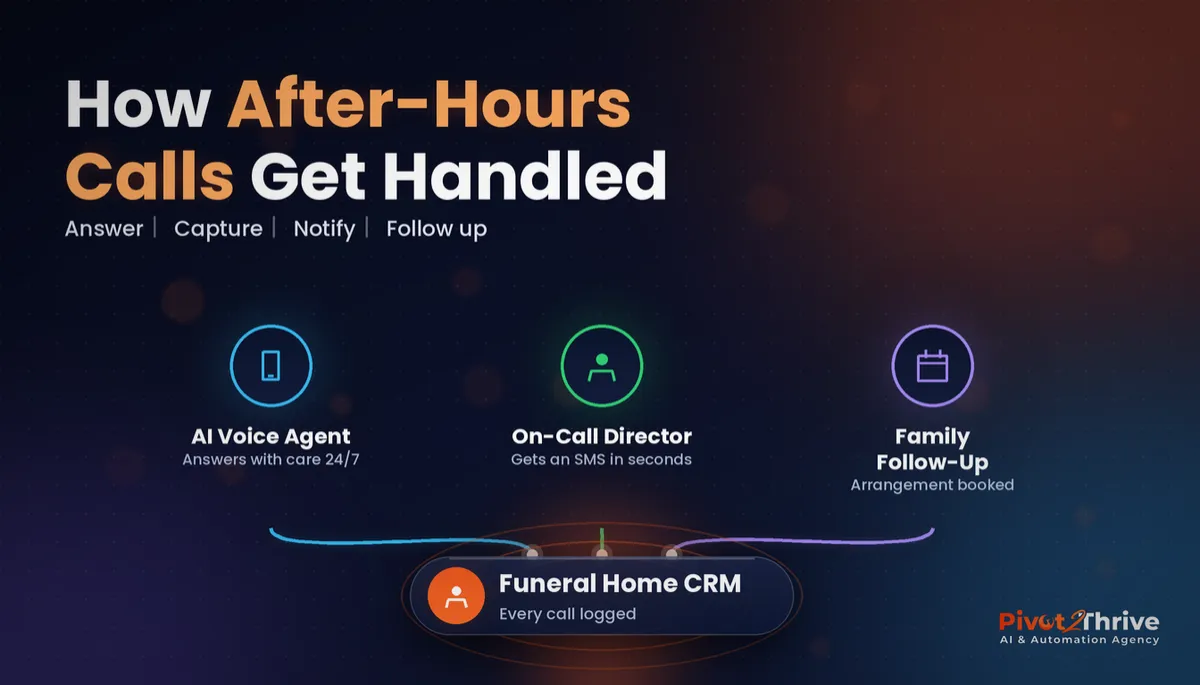
Funeral homes can use an AI voice agent to answer every call 24/7 with a gentle, scripted greeting, capture the essential details and alert the on-call director by SMS within seconds. AI should handle answering, notes, reminders and price-list enquiries; arrangements, condolences and any judgement call stay with your people.
I'm Dr Priya Jaganathan — Go High Level Certified Admin, Certified AI Tech Stack Consultant and keynote speaker. At Pivot 2 Thrive I build these systems for Australian businesses every week, so this guide is written from the build, not the brochure.
AI for funeral directors is…
AI for funeral directors is a set of tools that answers calls, captures details and handles routine admin, so your team can give its full attention to families. The core piece is usually an AI voice agent: a phone assistant that speaks naturally, follows a script you approve and never puts a caller on hold.
Around it sit simpler automations: a text to the on-call director, a contact record in your CRM, a reminder for the arrangement meeting and a follow-up message a few weeks after the service.
If you are weighing this against a traditional service, our comparison of an AI receptionist vs an answering service sets out the trade-offs plainly.
Why after-hours calls matter so much for Australian funeral homes
Death does not keep business hours. The ABS recorded 187,268 registered deaths in Australia in 2024 (Deaths, Australia, 2024), up from 183,131 in 2023, and many first calls come overnight from hospitals, aged care homes and families at home.
Families often ring two or three funeral homes. The one that answers kindly and explains the next step usually earns the trust, and the arrangement. A voicemail greeting at that moment feels like a closed door.
Price transparency is the other pressure. In NSW, funeral directors must show standard price information in their office and on their website under the Fair Trading funeral information standard, so families now call with sharper questions. An assistant that can calmly point them to your price list, then book a time with a director, takes that load off the phone. For the cost of the calls you are missing now, see the real cost of missing after-hours enquiries.
How to set up AI for a funeral home in 6 careful steps
This suits independent and family-owned funeral homes with one to three locations. A careful setup takes two to four weeks, most of it spent on the script and testing.
1. Map every type of call. List what callers need: a first call after a death, a price enquiry, a pre-planning question, a florist or celebrant, a family member checking service details. Each one gets its own path.
2. Write the script with your senior director. The greeting should be slow, warm and plain: who you are, that you are sorry for their loss and that someone will help right now. Never let the AI offer condolences it cannot mean or make promises about timing. It gathers the name, a callback number, where the person has passed and whether a doctor has attended.
3. Escalate first calls instantly. Any call about a death that has just happened triggers an SMS and a call to the on-call director within seconds, with the details already captured. The AI tells the family exactly when they will hear back, and the director rings them.
| Task | AI handles it | Human handles it |
|---|---|---|
| Answering after-hours calls | Yes, every call, 24/7 | Takes over for first calls within minutes |
| Capturing caller and transfer details | Yes, into the CRM | Reviews and confirms |
| Price-list and pre-planning enquiries | Shares the published price list, books a meeting | Runs the meeting |
| Arrangement meetings and condolences | No | Always |
| Service reminders for family and suppliers | Yes, by SMS and email | Approves the template |
| Bereavement follow-up weeks later | Sends a gentle, pre-approved message | Writes it and handles replies |
4. Handle recording and privacy properly. Tell callers the call may be recorded, store details in an Australian-compliant CRM and limit who can see them. Our guide to call recording and consent laws for AI voice agents explains what to say.
5. Test with real scenarios. Have your team role-play a distressed caller, a hospital nurse, a caller with a thick accent and someone who just wants prices. Fix anything that sounds rushed or robotic before going live.
6. Start after hours only, then review weekly. Run the AI from 6pm to 8am for the first month and read every call summary each week. Once the team trusts it, extend it to busy daytime overflow when everyone is at a service.
Families do not remember how fast you replied to an email. They remember whether someone answered when they rang at three in the morning.
An Australian example: a family funeral home in regional Victoria
Here is an illustrative scenario. A third-generation funeral home near Bendigo has two directors who share on-call duty. Overnight calls divert to whoever is rostered, and when they are driving or asleep, calls go to voicemail.
They set up an AI voice agent for after-hours calls only, with a greeting written by the senior director. First calls send an SMS with the caller's name, number and location to the on-call phone, then ring it.
Price enquiries receive a text link to the published price list and an offer to book a daytime meeting. Every call creates a contact record, so the morning team starts the day knowing exactly who needs a callback.
The owners notice the change in the mornings: no more scrolling through voicemails, no family who rang twice without an answer, and a director who sleeps a little better on call nights.
AI mistakes funeral directors should avoid
- Using a cheerful default voice. Generic assistant voices sound wrong here. Choose a calm, measured voice and slow the pace.
- Letting the AI arrange anything. Transfers, quotes and service details are human conversations. The AI captures and passes on; it never commits.
- No clear escalation. If a first call does not reach a director within minutes, the setup has failed. Test the alert path every week.
- Automated marketing to grieving families. Keep follow-up to one or two gentle, approved messages, and never add families to promotional lists without consent.
- Skipping the privacy notice. Callers must know when a call is recorded, and sensitive details belong in a secured CRM, not a shared inbox.
Even a simple missed call text back is a better safety net than voicemail while you plan the full setup.
Frequently Asked Questions
Can AI answer calls for a funeral home?
Yes. An AI voice agent can answer every call 24/7 with a gentle, approved greeting, capture the caller's details and alert the on-call funeral director by SMS and phone within seconds. The director then calls the family back personally.
Will families know they are speaking to AI?
They should. Best practice is a short, honest line in the greeting, such as saying an assistant is taking details so a director can call straight back. Most callers care far more about being answered kindly than about who answers first.
What should AI never do in a funeral business?
AI should never arrange a funeral, quote a final price, offer personal condolences or make promises about timing. Those conversations belong to a funeral director; the AI only answers, captures details and passes them on.
Is it legal to record funeral home calls in Australia?
Recording rules vary by state, so the safe approach is to tell every caller at the start that the call may be recorded. Store recordings and notes in a secure CRM with limited access, and get advice for your state if you are unsure.
How much does an AI receptionist cost for a funeral home?
Costs depend on call volume and how much is automated, so get a quote based on your actual calls. For most independent funeral homes, the comparison that matters is against an answering service or a director's overtime, not against doing nothing.
Can AI help with funeral price list enquiries in NSW?
Yes. NSW funeral directors must publish standard price information in-store and online, and an AI assistant can send callers a link to that published list. It should then offer a meeting with a director for anything specific.
Related Articles
Our services
- PowerPivot Leads Pro — AI lead generation and follow-up
- AI Receptionist Agent — answer every call, 24/7
Keep reading
 AI Receptionist vs Answering Service in Australia
 AI Voice Agent Call Recording and Consent Laws in Australia
 Missed Call Text Back: The Easiest Automation Australian Agencies Can Sell
 The Real Cost of Missing After-Hours Enquiries in Australia
Everything else