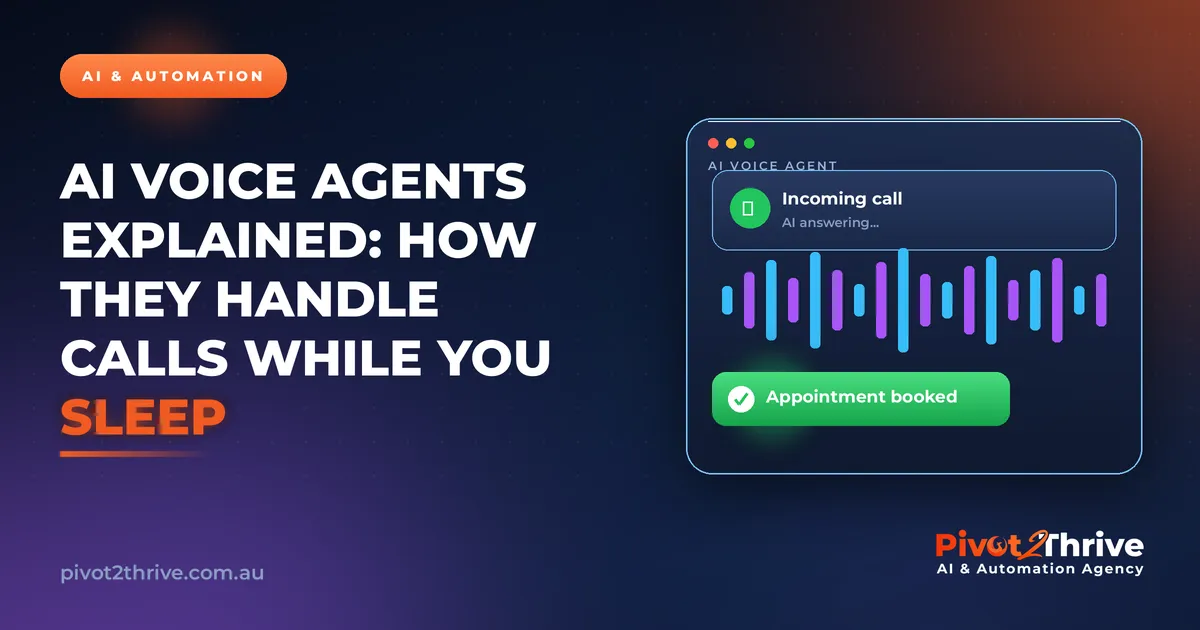
AI Voice Agents Explained: How They Handle Calls While You Sleep
AI voice agents in Australia are transforming how service businesses handle inbound phone calls — answering enquiries, qualifying leads, booking appointments, and routing urgent requests at 2am with the same consistency as 2pm. If you've ever lost a job, a patient, or a sale because nobody picked up the phone outside business hours, this article explains exactly how AI voice agents work, what they can and can't do, and whether they make sense for your business.
Dr Priya Jaganathan, Go High Level Certified Admin, Certified AI Tech Stack Consultant, and keynote speaker, has deployed AI voice agents across dozens of Australian businesses — from solo tradies to multi-location medical practices. At Pivot2Thrive, we build voice agent systems that handle real conversations, not robotic menu trees that frustrate callers into hanging up.
What Is an AI Voice Agent?
An AI voice agent is a software system that uses natural language processing and speech recognition to conduct real-time phone conversations with callers. Unlike traditional IVR systems that force callers through rigid menu options ("Press 1 for appointments, Press 2 for billing"), AI voice agents engage in natural, flowing dialogue. The caller speaks normally, the AI understands the intent, responds conversationally, and takes action — booking an appointment, capturing contact details, answering frequently asked questions, or escalating to a human when the situation requires it.
Modern AI voice agents sound remarkably natural. They handle interruptions, understand Australian accents and colloquialisms, manage multi-turn conversations where the topic shifts, and adapt their responses based on context. They're not perfect — complex emotional conversations or highly unusual requests still benefit from human involvement — but for the 70-80% of inbound calls that follow predictable patterns, they perform at or above human receptionist standards.
Why Australian Businesses Are Adopting AI Voice Agents
The economics are compelling and the timing is critical. According to a 2025 Salesforce survey, 64% of Australian consumers expect businesses to respond to phone enquiries within 5 minutes. Yet research from CallRail shows that the average small business misses 62% of inbound calls during business hours and nearly 100% after hours. Every missed call is a potential customer choosing your competitor instead.
The financial impact is staggering. For a trades business where the average job value is $1,200, missing just 5 calls per week represents $312,000 in potential annual revenue walking out the door. For a dental practice where a new patient is worth $3,000-$5,000 in lifetime value, 3 missed calls per week is over $600,000 in lost patient revenue annually. AI voice agents don't miss calls. They don't call in sick. They don't put callers on hold. They answer every call, every time, within two rings.
How AI Voice Agents Actually Work: The Technical Process
Step 1: Call Interception
When a call comes in to your business number, the AI voice agent answers — either as the primary responder or as a fallback after a set number of rings. The system can be configured to handle all calls, only after-hours calls, or overflow calls when your team is busy. The caller hears a natural greeting customised for your business: "Thanks for calling Smith Plumbing, this is the after-hours assistant. How can I help you today?"
Step 2: Speech Recognition and Intent Detection
As the caller speaks, the AI converts speech to text in real time using advanced speech recognition models trained on Australian English. The system then analyses the text to determine the caller's intent — are they enquiring about a service, trying to book an appointment, asking about pricing, reporting an emergency, or requesting a callback? Intent detection happens in milliseconds, allowing the AI to respond without awkward pauses.
Step 3: Contextual Response Generation
Based on the detected intent, the AI generates an appropriate response using a knowledge base specific to your business. This knowledge base includes your services, pricing guidelines, booking availability, FAQs, business policies, and escalation rules. The response is converted from text back to natural-sounding speech and delivered to the caller. The entire process — hearing the caller, understanding intent, generating a response, and speaking — takes under 1 second.
Step 4: Action Execution
Beyond conversation, AI voice agents take action during the call. They can book appointments directly into your calendar system, send SMS confirmations to the caller, create or update contact records in your CRM, trigger follow-up workflows such as sending a quote request to your team, transfer the call to a specific team member for urgent matters, and send post-call summaries to the business owner via SMS or email. These actions happen in real time during the call, not after it ends.
Step 5: Post-Call Processing
After every call, the AI generates a complete record including a full transcript, caller intent classification, actions taken during the call, any follow-up tasks created, and a priority rating based on the urgency and value of the enquiry. This data feeds into your CRM and reporting dashboard, giving you complete visibility into every caller interaction without listening to recordings.
Want to see an AI voice agent handle calls for your business? Book a live demonstration with Dr Priya Jaganathan and hear the system in action with your own business scenarios.
Real-World Application: A Brisbane Trades Business
Consider a plumbing company in Brisbane running a team of 6 plumbers. Before AI voice agents, the owner's wife handled calls during business hours, and after-hours calls went to voicemail. They estimated 8-12 missed calls per week during busy periods and almost all after-hours calls were lost entirely.
After deploying an AI voice agent, every call was answered within two rings — 24 hours a day, 7 days a week. The AI qualified each caller by asking about the nature of the plumbing issue, the property type, the urgency level, and the preferred appointment time. Emergency calls were immediately transferred to the on-call plumber. Non-urgent enquiries were booked into the next available slot and confirmed via SMS.
Within the first 60 days, the business captured an additional 34 qualified leads per month that would have previously been lost. At an average job value of $850, that represented $28,900 in additional monthly revenue — from leads that were already calling but simply weren't being answered. The AI voice agent cost $497 per month. The return on investment was immediate and obvious.
What AI Voice Agents Can and Cannot Do
What they handle well: Answering frequently asked questions about services, hours, and pricing. Booking and confirming appointments. Qualifying leads by asking structured questions. Routing urgent calls to the right person. Capturing contact information and call details. Sending SMS confirmations and follow-up messages. Handling high call volumes without degradation in quality.
What they struggle with: Highly emotional conversations such as complaints or disputes that require empathy and nuanced judgment. Complex technical discussions that go beyond the knowledge base. Calls in extremely noisy environments where speech recognition accuracy drops. Conversations requiring access to information the system hasn't been trained on. Negotiation or sales conversations that require real-time judgment calls.
The key is understanding that AI voice agents don't replace your team — they handle the predictable, repetitive calls so your team can focus on the conversations that genuinely require human judgment and relationship skills.
Common Mistakes When Implementing AI Voice Agents
Setting unrealistic expectations. AI voice agents handle 70-85% of typical inbound calls effectively. Expecting 100% coverage leads to disappointment. Design your system with clear escalation paths for the calls AI can't handle well.
Skipping the knowledge base build. The quality of an AI voice agent depends entirely on the quality of its training data. Investing time upfront to build a comprehensive knowledge base — covering every common question, service detail, and business policy — is the difference between an agent that impresses callers and one that frustrates them.
Not telling callers they're speaking with AI. Transparency matters. Australian consumer expectations and emerging regulations favour disclosure. A simple acknowledgment ("You're speaking with our AI assistant") builds trust rather than eroding it. Most callers don't mind as long as the AI is helpful.
Deploying without testing with real scenarios. Before going live, test the voice agent with 50-100 realistic call scenarios covering common and edge cases. Record these test calls, review the transcripts, and refine responses before any real caller interacts with the system.
Ignoring post-deployment optimisation. AI voice agents improve significantly over the first 30-60 days as you review real call data and refine responses. Businesses that "set and forget" miss out on 30-50% of the potential performance improvement that comes from iterative tuning.
Frequently Asked Questions
How much does an AI voice agent cost for a small business?
AI voice agent costs typically include a setup fee ($2,000-$8,000 depending on complexity and knowledge base size) and a monthly service fee ($297-$997/month covering the AI platform, phone infrastructure, and ongoing maintenance). For most small businesses handling 200-500 calls per month, total monthly cost lands between $400-$800. Compare this to a part-time receptionist at $2,500-$3,500/month or a full-time receptionist at $4,500-$6,000/month — and the AI works 24/7 without sick days, holidays, or training periods.
Will my customers know they're talking to an AI?
Modern AI voice agents sound natural enough that many callers don't immediately recognise they're speaking with AI. However, best practice — and increasingly, regulatory expectation — is to disclose that the caller is interacting with an AI assistant. Most callers are comfortable with this as long as the AI is responsive, helpful, and capable of transferring to a human when needed. Transparency builds trust; deception erodes it.
Can AI voice agents handle Australian accents?
Yes. Current speech recognition models are trained on diverse English accents including Australian English. They handle standard Australian accents with high accuracy. Thick regional accents or heavy non-English accents may occasionally reduce accuracy, but performance improves continuously as models are refined. In testing across Australian businesses, speech recognition accuracy typically exceeds 92% for standard conversational English.
What happens if the AI can't answer a caller's question?
Well-designed AI voice agents have built-in escalation protocols. If the AI detects that it can't adequately address a caller's needs — through confidence scoring or when the caller explicitly asks for a human — it can transfer the call to a designated team member, take a detailed message and arrange a callback within a specified timeframe, or send an immediate notification to the business owner via SMS with call details. The goal is ensuring no caller reaches a dead end.
How long does it take to set up an AI voice agent?
A standard implementation takes 2-4 weeks. The first week covers knowledge base creation and business process mapping. The second week handles technical configuration and integration with your existing phone system and CRM. The third week is testing and refinement. The fourth week is live deployment with monitoring. Simpler implementations — such as an after-hours-only agent with basic FAQ handling — can be live within 7-10 days.
Stop Losing Revenue to Missed Calls
Every unanswered call is revenue your business earned through marketing, reputation, and word of mouth — then lost at the final step because nobody picked up the phone. AI voice agents eliminate this gap permanently, answering every call with consistency, professionalism, and the ability to take action in real time.
At Pivot2Thrive, we deploy AI voice agents that are custom-built for your business, your industry, and your callers. Book a free demonstration with Dr Priya Jaganathan and hear exactly how an AI voice agent would handle your business calls.
Related Articles
Related Articles
AI & Automation
- AI Voice Agents Explained: How They Handle Calls While You Sleep
- AI Voice Agents for Australian Trades Businesses: Book Jobs While You're On the Tools
- AI Voice Agents for Tradies: Stop Missing Job Calls (2026 Guide)
GHL Agency Systems
- How to Sell AI Voice Agents to Australian Small Businesses (2026 Guide)
- AI Agency Sales Objections: How to Handle the 7 Pushbacks Australian Clients Give (2026 Guide)
- AI Agency Tech Stack: The Only Tools You Actually Need in 2026
