AI Voice Agents for Australian Trades Businesses: Never Miss Another Job Call
AI voice agents for trades businesses solve the most expensive problem in your operation: the calls you never answer. When you are under a house, on a roof or elbow-deep in a switchboard, your phone rings out, and that caller does what every Australian customer does next: they ring the next tradie on the list. Every missed call is a quoted job you never saw, and for most trades businesses it happens several times a day.
Dr Priya Jaganathan, Go High Level Certified Admin, Certified AI Tech Stack Consultant and keynote speaker, has built AI phone and follow-up systems for Australian trades and service businesses through Pivot2Thrive, and the pattern is consistent: the fastest revenue lift rarely comes from more advertising. It comes from capturing the enquiries the business already generates.
What an AI Voice Agent Actually Is
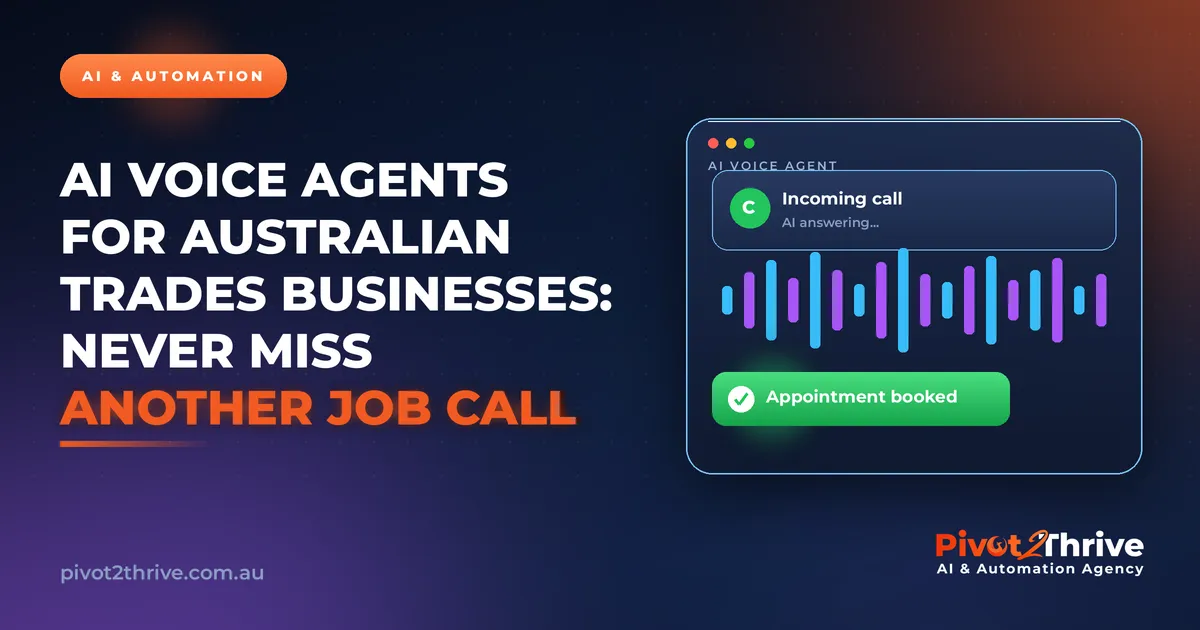
An AI voice agent is software that answers your business phone with a natural, conversational voice, around the clock. It greets the caller, asks the questions you would ask — suburb, type of job, urgency, access details — answers common questions about your services and rough pricing, and then books the job straight into your calendar or sends you a summary by text. Unlike an answering service, it never puts callers in a queue, never takes a garbled message, and never clocks off. Unlike voicemail, people actually talk to it: most callers hang up on voicemail, but they will happily tell a helpful voice what they need.
Why This Matters: The Cost of a Missed Call
Industry studies have consistently found that businesses miss around 25 to 40 per cent of inbound calls, and that the majority of callers who reach voicemail simply hang up and call a competitor. Run the maths on a trades business: if you miss just five calls a week, and only two of those were genuine jobs at an average invoice of $600, that is $62,000 a year in work handed to competitors — before you count repeat business and referrals from those customers. For emergency trades such as plumbing and electrical, where the first business to answer usually wins the job, the number is worse. Answering every call is not a customer service nicety; it is the cheapest lead generation you will ever do, because you have already paid to make the phone ring.
How to Set Up an AI Voice Agent: A Practical Framework
Here is the process Pivot2Thrive uses to take a trades business from missed calls to a fully booked calendar. You can attempt it yourself or have it built for you; either way, the steps are the same.
- 1. Audit your call flow first. Pull your phone records for the last 30 days. Count total inbound calls, calls answered, and calls that rang out or hit voicemail. Most owners guess they miss "a few" and discover it is 30 per cent or more. This baseline is how you will measure the system's return.
- 2. Script the ten questions you always ask. Write down exactly what you ask a new caller: suburb, job type, urgency, property access, photos, preferred times. The voice agent will follow this script, so make it sound like you. Include the questions that disqualify bad jobs — outside your service area, jobs too small to be worth the travel — so the agent filters as well as captures.
- 3. Decide what the agent can and cannot do. A good configuration lets the agent give indicative pricing ranges, book standard jobs directly into your calendar, and flag emergencies for an immediate transfer or instant SMS to your mobile. Keep firm quotes and complex commercial work as human follow-ups. Clear boundaries keep the agent useful and keep you in control.
- 4. Connect it to a real calendar and CRM. The agent must write bookings into a live calendar with travel buffers, and log every call, transcript and caller detail into a CRM such as GoHighLevel. A voice agent without a CRM behind it is just a fancy message-taker. With one, every caller becomes a contact who gets confirmations, reminders and review requests automatically.
- 5. Add missed-call and after-hours coverage in stages. Start by routing only the calls you currently lose — after-hours, weekends and overflow when you are on another line. You lose nothing, because these calls were going unanswered anyway. Once you trust the transcripts, promote the agent to first answer and keep your mobile as the escalation path.
- 6. Set up instant SMS follow-up. Every call, answered or not, should trigger a text to the caller within seconds: a booking confirmation, a link to send photos of the job, or a "sorry we missed you, what do you need?" message. Speed to lead applies to phones too, and the combination of voice plus SMS is what lifts booking rates.
- 7. Review transcripts weekly for the first month. Read what callers actually asked and how the agent responded. Tighten the script, add answers for questions you did not anticipate, and adjust pricing ranges. A voice agent improves fast with feedback, but only if someone reads the transcripts.
Want this built and managed for you instead of becoming your weekend project? Book a free call with Pivot2Thrive and see a voice agent configured for your trade.
A Real-World Australian Scenario
Take a two-van electrical business in Brisbane's northern suburbs — a setup Pivot2Thrive sees constantly. The owner ran the tools and the phone, his partner handled invoicing at night, and the call audit showed 34 per cent of inbound calls going unanswered, mostly between 7am and 4pm when both electricians were on jobs. The fix followed the framework above: an AI voice agent answering overflow and after-hours calls, qualifying by suburb and job type, booking standard jobs into a shared calendar with travel buffers, and texting emergency callers a "we're calling you back within 10 minutes" message that also alerted the owner's phone. Within the first quarter the business was booking an additional eight to ten jobs a month it would previously have lost, worth more than $5,000 in monthly revenue against a system cost of a few hundred dollars. The owner's summary: it was the first hire that never called in sick.
Common Mistakes Trades Businesses Make
- Making the agent pretend to be human. Callers do not mind talking to an AI that is upfront and helpful. They do mind being deceived. A simple "you've reached the assistant for [business name]" builds trust.
- Letting it answer everything from day one. Start with the calls you already miss. Earn your own confidence with transcripts before making it the front door.
- No calendar integration. If the agent takes messages instead of bookings, you have automated your voicemail, not your bookings. The value is in jobs landing on the calendar.
- Skipping the disqualification rules. An agent that books every caller will fill your calendar with $80 jobs an hour's drive away. Build your minimums and service area into the script.
- Set-and-forget configuration. Prices change, services change, staff change. Review the agent's script quarterly like you would service a vehicle.
Frequently Asked Questions
How much does an AI voice agent cost for a trades business in Australia?
Expect a setup cost between $1,500 and $5,000 depending on complexity, plus a monthly fee of roughly $300 to $800 covering call minutes, AI usage and management. Against the value of two or three extra booked jobs a month, most trades businesses see the system pay for itself within the first few weeks.
Will customers hang up when they realise it's an AI?
Some callers are surprised, but hang-up rates on well-configured agents are far lower than voicemail abandonment. The comparison that matters is not AI versus you answering — it is AI versus the call ringing out. A helpful voice that books a real appointment beats a missed call every time.
Can an AI voice agent handle emergency call-outs?
Yes, with the right rules. Configure the agent to recognise emergency keywords — burst pipe, no power, gas smell — and immediately transfer the call to your mobile or send you an urgent SMS while telling the caller help is being arranged. You stay the decision-maker; the agent just makes sure the emergency reaches you.
What happens to the call recordings and customer details?
Calls are transcribed and stored in your CRM, so you own the records. Choose a provider that stores data securely, and mention call recording in your greeting to stay on the right side of Australian recording rules, which vary by state. Your setup partner should configure this disclosure for you.
Do I still need a receptionist or my partner answering phones?
Many trades businesses keep a human on the phones during core hours and use the agent for overflow, after-hours and weekends. The agent does not replace judgement on complex quotes; it replaces the missed calls, the interrupted jobs and the 9pm message-bank catch-up. Most owners find the human workload drops by more than half.
Every week you wait, the missed calls keep going to your competitors. Book a call with Pivot2Thrive to hear a voice agent demo configured for your trade, or learn more at pivot2thrive.com.au.
Related Articles
- PowerPivot Leads Pro: done-for-you lead generation
- AI Receptionist Agent: never miss another enquiry
- More from the Pivot2Thrive blog
Related Articles
AI & Automation
- AI Voice Agents for Australian Tradies: Never Miss a Job Call Again (2026)
- AI Voice Agents for Australian Trades Businesses: Book Jobs While You're On the Tools
- AI for Electricians: Never Miss Another Job Enquiry
GHL Agency Systems
- How to Sell AI Voice Agents to Australian Small Businesses (2026 Guide)
- AI Automation Agency Wollongong: Lead Systems and AI Receptionists for Illawarra Businesses
