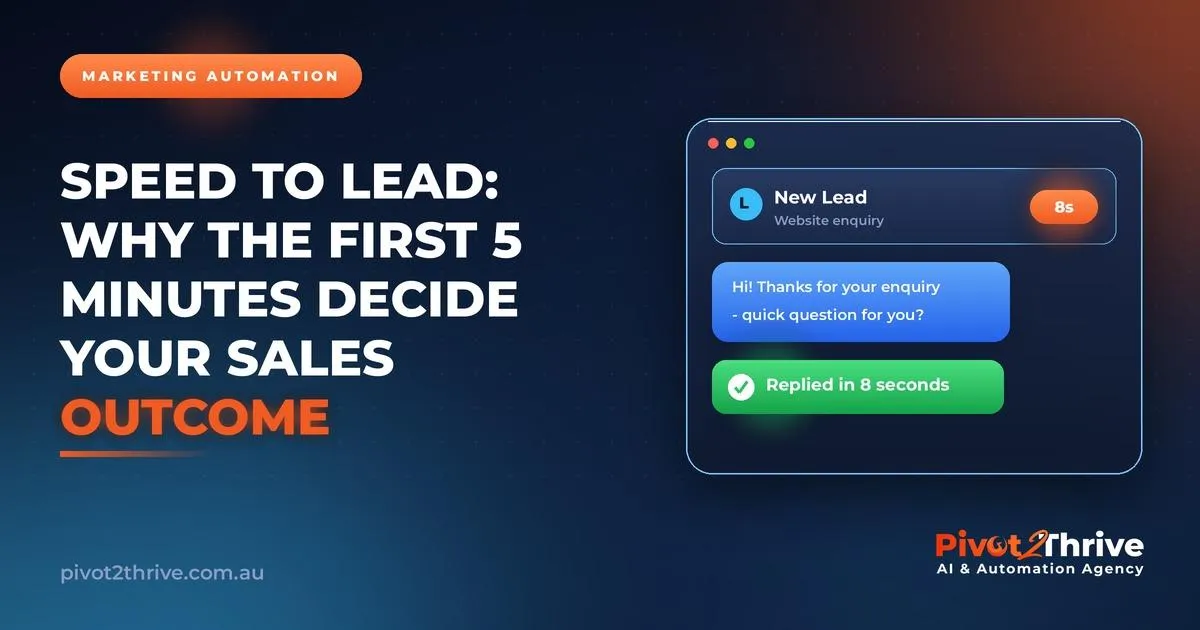
Speed to Lead: Why the First 5 Minutes Decide Your Sales Outcome
Speed to lead is the single highest-leverage metric most Australian businesses ignore — and it is quietly costing them the majority of their enquiries. When a prospect fills in your form or rings your number, a countdown starts. Reply in the first few minutes and you usually win the conversation. Reply an hour later and you are often talking to someone who has already booked with a competitor. The first 5 minutes decide the outcome.
This breakdown comes from an operator who installs lead-response systems for a living. Dr Priya Jaganathan is a Go High Level Certified Admin, a Certified AI Tech Stack Consultant and a keynote speaker who builds automated speed-to-lead systems for Australian service businesses. The numbers below are why this metric deserves your attention before anything else in your funnel.
Speed to lead is the time between enquiry and your first response
Speed to lead is the elapsed time between a prospect making contact — a web form, a call, a message — and your business making meaningful first contact back. It is measured in seconds and minutes, not hours. A business with strong speed to lead responds almost instantly, every time, regardless of whether it is a weekday morning or 9pm on a Sunday.
The reason it matters more than almost any other lead metric is simple: attention and intent both decay fast. A prospect who has just enquired is at peak interest. Every minute that passes, that interest cools and the odds they have contacted a competitor rise. Speed to lead is not about being pushy — it is about reaching people while they are still actively looking.
Why it matters: the 5-minute rule
The most-cited research on this comes from a study of thousands of inbound leads, which found that contacting a lead within 5 minutes versus 30 minutes made the business roughly 100 times more likely to connect with that lead, and the odds of qualifying the lead dropped sharply after the first five minutes. Other lead-response studies have found that the average business takes far longer than five minutes to respond — often hours — leaving an enormous gap between what works and what most businesses actually do.
That gap is the opportunity. You do not need more leads to grow; you need to stop losing the ones you already pay for. A business that responds in under a minute, automatically, captures conversations its slower competitors never even reach.
The framework: how to build a 5-minute speed-to-lead system
Human reaction time cannot reliably beat five minutes, every time, around the clock. Automation can. Here is how to build a system that responds instantly without burning out your team.
1. Capture every lead source in one place. Route web forms, calls, Facebook and Google leads, and chat enquiries into a single CRM (GoHighLevel is commonly used for this). You cannot respond fast to leads scattered across five inboxes.
2. Trigger an instant automated first response. The moment a lead arrives, fire an automatic SMS and email within seconds — a friendly acknowledgement and one qualifying question. This single step closes most of the response-time gap immediately.
3. Add an AI agent for the conversation. Use an AI chat or voice agent to answer follow-up questions, qualify the lead and offer a booking link, so the prospect can move forward even when no human is available.
4. Book straight into the calendar. Let the system offer live appointment times and confirm the booking automatically. Removing the back-and-forth of scheduling is where a lot of leads are lost.
5. Build a persistent follow-up sequence. Most leads are not lost at first contact — they are lost in the silence afterwards. Set an automated multi-touch sequence across SMS and email over the following days for anyone who does not book immediately.
6. Use missed-call text-back. When a call goes unanswered, automatically text the caller within seconds. This recovers a huge share of enquiries that would otherwise vanish.
7. Route hot leads to a human fast. When a lead is qualified and ready, notify your salesperson immediately so they can take over a warm, pre-qualified conversation rather than chasing cold ones.
8. Measure your actual response time. Track time-to-first-response and time-to-booking as core metrics. What gets measured gets improved; most businesses have never measured this at all.
Want every enquiry answered in under 60 seconds, automatically? Book a strategy session here to map a speed-to-lead system for your business.
Australian real-world example
Consider a Sydney-based professional services firm generating leads through Google and a website enquiry form. Before automation, enquiries landed in a shared inbox and were actioned whenever someone got to them — often hours later, and rarely on weekends. Prospects who enquired on a Friday night frequently signed with a competitor before Monday. After installing an automated speed-to-lead system, every enquiry triggered an SMS and email within seconds, an AI agent answered initial questions and offered times, and qualified leads were routed to a consultant immediately. The practical effect for a firm like this is that the same volume of enquiries produced noticeably more booked consultations — purely because the business stopped letting warm leads go cold in an inbox.
Common mistakes to avoid
- Relying on humans to respond instantly. No team can answer every lead in under five minutes, 24/7. Without automation, your response time collapses on evenings and weekends — exactly when many leads arrive.
- Stopping after one follow-up. A single text or call is not a follow-up system. The majority of conversions come from persistent, multi-touch sequences over several days.
- Ignoring missed calls. Unanswered calls with no text-back are pure lost revenue. Automated missed-call text-back is one of the fastest wins available.
- Scattering leads across channels. If enquiries live in separate inboxes and platforms, fast response is impossible. Centralise everything first.
- Never measuring response time. You cannot improve what you do not track. If you do not know your current time-to-first-response, that is the first thing to fix.
Frequently asked questions
What is a good speed-to-lead response time?
The benchmark to beat is five minutes, and the closer you get to instant, the better your results. Leading research shows the odds of connecting and qualifying a lead drop sharply after the first five minutes. With automation, businesses can reliably respond in under 60 seconds, every time, which puts them well ahead of competitors who take hours.
How do I respond to leads instantly without hiring more staff?
Automation handles the instant first response so your team does not have to. A CRM-triggered SMS and email fire within seconds of an enquiry, an AI agent qualifies and books, and a human is brought in only when the lead is warm and ready. This delivers sub-minute response without adding headcount or after-hours shifts.
Does fast follow-up annoy prospects?
A prompt, helpful first response to someone who just enquired is expected, not intrusive — they reached out to you. The annoyance comes from being ignored or chased days later with a generic call. A friendly instant acknowledgement that answers their question and offers a time is exactly what an active buyer wants.
Which tools do I need for a speed-to-lead system?
At minimum you need a CRM that centralises all lead sources and triggers automated responses, plus messaging (SMS and email) and a booking calendar. Platforms like GoHighLevel combine these in one place, and an AI agent can be layered on to handle conversations and qualification automatically.
How quickly can a speed-to-lead system be implemented?
A focused build — centralising lead sources, setting up instant responses, follow-up sequences and missed-call text-back — can typically be live within a few weeks. The biggest gains, instant first response and missed-call recovery, are often switched on first because they deliver the fastest return.
Stop losing leads you already paid for
You do not have a lead problem; you likely have a response-time problem. Fix speed to lead and the same marketing spend produces more booked appointments. To build a system that answers every enquiry in under a minute, book a strategy session here or learn more at pivot2thrive.com.au.
Related articles
Related Articles
Marketing Automation
- Speed to Lead in Australia: Why the First 5 Minutes Decide the Sale (2026)
- Speed to Lead: Why the First 10 Seconds Decide Your Revenue
- Speed to Lead: Why the First 10 Seconds Decide Your Revenue
GHL Agency Systems
- Client Onboarding for AI Agencies: The First 14 Days That Decide Retention
- AI Agency Sales Objections: How to Handle the 7 Pushbacks Australian Clients Give (2026 Guide)
- AI Automation Agency Wollongong: Lead Systems and AI Receptionists for Illawarra Businesses
