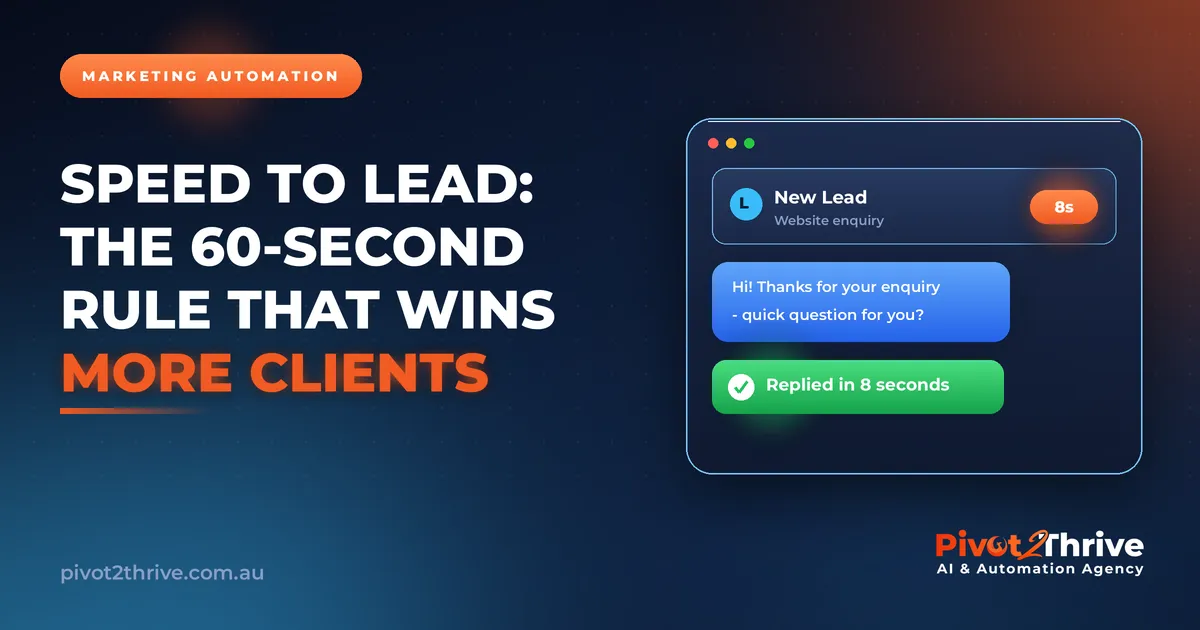
Speed to Lead: The 60-Second Rule That Wins More Clients
Speed to lead is the single biggest lever most Australian service businesses are ignoring, and it is quietly handing your competitors the clients you paid to attract. The problem is simple: a prospect fills in your form or rings your number, and minutes or hours pass before anyone responds. By then they have moved on. The opportunity is just as simple: be the business that replies in seconds, and you win the work before the competition wakes up.
This breakdown comes from Dr Priya Jaganathan, a Go High Level Certified Admin, Certified AI Tech Stack Consultant and keynote speaker who builds automated lead-response systems for agencies and service businesses across Australia. The 60-second rule below is the standard that consistently separates the businesses that grow from the ones that wonder why their ads "do not work".
Speed to lead is the time between an enquiry arriving and your first genuine response
Speed to lead is the measurement of how fast your business responds to a new enquiry, from the moment a form is submitted, a call is missed, or a message lands, to the moment the prospect hears back from you in a real, helpful way. It is not about sending a generic "we received your enquiry" auto-reply. It is about engaging the prospect while their intent is still hot and moving them toward a booked conversation.
The reason it matters so much is human behaviour. When someone reaches out, they are usually contacting several providers at once and their interest peaks in the first few minutes. The business that responds first earns the conversation, the trust, and usually the sale, regardless of who has the better website or the lower price.
Why the first 60 seconds decide the deal
The widely cited Lead Response Management study found that the odds of qualifying a lead are dramatically higher when contact is made within five minutes compared with even thirty minutes later, with the likelihood of meaningful contact dropping sharply as time passes. Other industry research has shown that the majority of buyers choose the business that responds to them first. Yet most small and mid-sized service businesses still take hours, or never respond at all, because the enquiry sits in an inbox while the team is busy doing the actual work. That gap is pure margin sitting on the table: you have already paid to generate the lead, so capturing it costs almost nothing extra and converting it is the cheapest growth available.
The framework: how to win with the 60-second rule
Responding in under a minute, every time, is only possible with a system. Manual effort cannot guarantee it. Build it in this order.
- Step 1 — Measure your current speed to lead. For one week, record how long each enquiry waits before a real response. Most businesses are shocked by the answer. You cannot fix what you do not measure.
- Step 2 — Centralise every enquiry into one place. Route forms, calls, website chat, and social messages into a single CRM so nothing is missed and everything can be actioned instantly. Scattered enquiries are the root cause of slow responses.
- Step 3 — Automate the first touch within seconds. Trigger an instant, personalised SMS and email the moment an enquiry arrives. A message like "Thanks for your enquiry, I have one quick question to get you sorted" keeps the prospect engaged while a human or AI takes over.
- Step 4 — Add an AI responder for the conversation. Use an AI agent to ask qualifying questions, answer common ones, and offer booking times, so the prospect is progressing even outside business hours. This is what makes sub-60-second response sustainable.
- Step 5 — Book the call, do not just reply. The goal of the first response is a booked appointment or call, not a back-and-forth. Put a live calendar in front of the prospect while they are still engaged.
- Step 6 — Build a follow-up sequence for non-responders. Most leads do not convert on the first message. A structured sequence of reminders across SMS and email over the following days recovers a large share of enquiries that would otherwise go cold.
- Step 7 — Review and tighten weekly. Track response time, booking rate, and show-up rate. Small improvements to your first message and follow-up timing compound into significantly more booked work.
Want sub-60-second response running in your business? Book a free strategy call here and we will map a speed-to-lead system that fits how you already work.
An Australian real-world example
A Sydney-based trades and home-services business was spending steadily on lead generation but converting far fewer quotes than expected. When they measured their speed to lead, the average first response was over four hours, because enquiries landed while the team was on the tools. They installed an automated speed-to-lead system: every enquiry triggered an instant SMS, an AI responder asked two qualifying questions and offered a quote time, and a follow-up sequence chased anyone who went quiet. With response time cut from hours to seconds, the same ad spend produced noticeably more booked quotes, simply because they were now first to reach the customer. Nothing about their marketing changed, only the speed of the response.
Common mistakes to avoid
- Relying on humans for instant response. Even a great team cannot reply in 60 seconds while serving customers. Automate the first touch.
- Sending a dead-end auto-reply. "We will get back to you soon" stalls momentum. The first message should move the prospect toward booking.
- Stopping after one message. Most enquiries need several touches. No follow-up sequence means leaving easy revenue behind.
- Ignoring after-hours enquiries. Many leads arrive evenings and weekends. A system that only works business hours misses the fastest wins.
- Not measuring. Without tracking response time and booking rate, you cannot improve and cannot prove the impact.
Frequently Asked Questions
What is a good speed-to-lead time?
Aim to make first contact within 60 seconds and ideally engage the prospect within five minutes. The research is clear that conversion drops steeply after the first few minutes, so faster is always better. An automated first touch is the only reliable way to hit that consistently.
Does automation make the response feel impersonal?
Not when it is done well. A good system uses the prospect's name, references their specific enquiry, and asks a relevant question. Prospects care far more about a fast, helpful reply than about whether the first message was triggered automatically.
Can a small business realistically respond in under a minute?
Yes, but only with automation. A small team cannot manually guarantee sub-60-second response while doing their core work. By automating the first touch and using an AI responder, even a one or two-person business can respond instantly around the clock.
What tools do I need to improve speed to lead?
You need a CRM that centralises every enquiry, automated SMS and email triggers, a connected calendar for booking, and ideally an AI responder. Platforms like GoHighLevel combine these in one place, which keeps the system reliable and simple to run.
How quickly will I see results?
Because the leads are already coming in, improvements often appear within the first weeks as previously missed enquiries start converting. The exact lift depends on your current response time, your volume, and the strength of your follow-up sequence.
Be the business that responds first
Speed to lead is the cheapest growth available, because you have already paid to generate the enquiry. Closing the response gap turns existing leads into booked work without spending another dollar on marketing. To build a sub-60-second system for your business, book a free strategy call with our team or learn more at pivot2thrive.com.au.
Related Articles
Related Articles
Marketing Automation
- Speed to Lead: Why Replying in 8 Seconds Wins More Clients
- Speed to Lead: Why Replying in Seconds Wins More Clients
- Speed to Lead: Why Responding in 5 Minutes Wins More Clients
GHL Agency Systems
- How to Write an AI Agency Case Study That Wins Clients (2026 Guide)
- AI Agency Sales Objections: How to Handle the 7 Pushbacks Australian Clients Give (2026 Guide)
- AI Agency Referral Partnerships: How to Get Clients from Accountants, Bookkeepers and Web Designers (2026 Guide)
