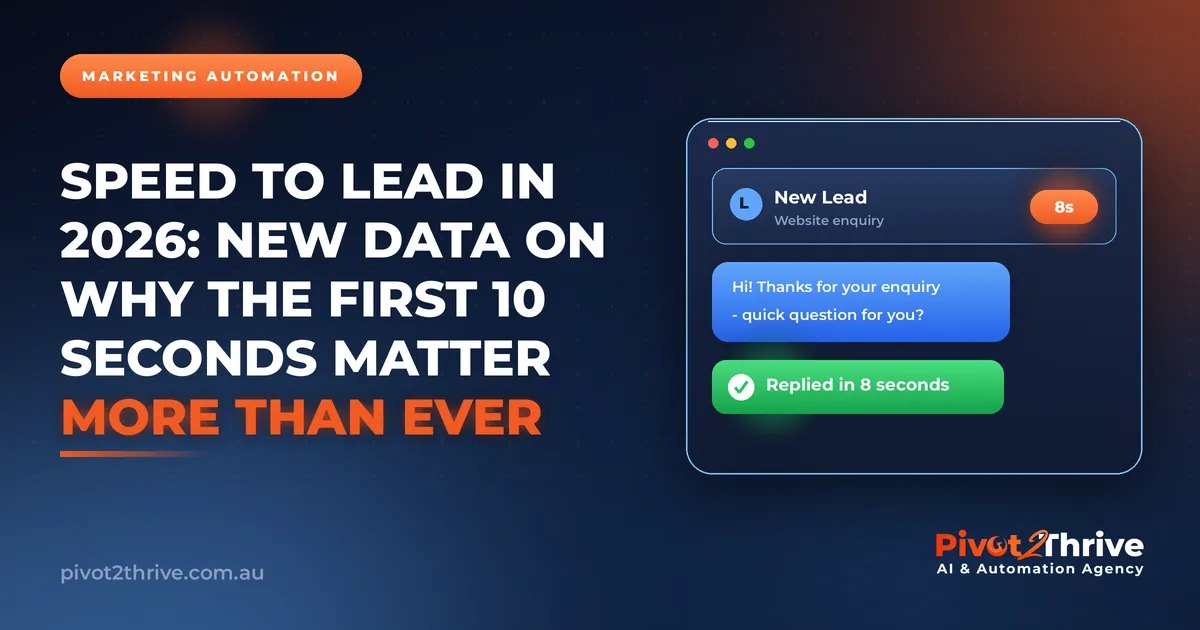
Speed to Lead in 2026: New Data on Why the First 10 Seconds Matter More Than Ever
Dr Priya Jaganathan, Go High Level Certified Admin, Certified AI Tech Stack Consultant, and keynote speaker, has built speed-to-lead systems for hundreds of Australian businesses through Pivot2Thrive. The numbers in this article come from real implementations, not theory.
What Speed to Lead Means in 2026
Speed to lead is the time between when a potential customer submits an enquiry and when your business responds. In 2026, this metric has become the primary predictor of conversion rates for service businesses. A fast response signals competence, availability, and professionalism. A slow response — or worse, no response — tells the prospect to call your competitor.
The 2026 Data: Why This Matters More Than Ever
There has never been a time when response speed mattered more. Consumer expectations have been permanently reset by AI-powered experiences. When someone asks a question on ChatGPT and gets an answer in two seconds, they expect your business to operate at a similar pace. Industry benchmarks from early 2026 show that leads contacted within 10 seconds convert at 4–7x the rate of leads contacted within 10 minutes. The average Australian SMB still takes over 40 minutes to respond to a web enquiry. That gap between expectation and reality is where revenue disappears.
Consider the maths. If your business generates 100 leads per month and converts 15% with a 40-minute average response time, improving that to under 60 seconds could push conversion rates to 25–35%. On a $3,000 average job value, that's the difference between $45,000 and $105,000 in monthly revenue from the same lead volume.
How to Build a Sub-10-Second Response System
Layer 1: Instant AI Acknowledgement
Every form submission, missed call, and social media message should trigger an immediate AI response. This isn't a generic auto-reply saying "We received your message." It's an AI-powered response that acknowledges their specific enquiry, asks a qualifying question, and sets expectations for next steps. GoHighLevel's workflow automation makes this straightforward to build. The AI response happens in under five seconds, every time, 24/7.
Layer 2: AI Voice Agent for Phone Enquiries
Phone calls remain the highest-intent lead channel for service businesses. An AI voice agent answers every call within two rings, qualifies the caller, books appointments directly into your calendar, and sends a summary to your team. No missed calls. No voicemail. No callbacks required. The caller gets immediate service, and your team gets pre-qualified leads delivered to their CRM.
Layer 3: Intelligent Routing for Complex Enquiries
Not every enquiry can be fully handled by AI. The system should intelligently route complex or high-value leads to the right team member with full context. The AI has already qualified the lead, captured their details, and identified their needs. Your team member picks up a warm, informed conversation instead of starting from scratch.
Layer 4: Automated Follow-Up Sequences
The first response is critical, but the follow-up is where most deals are actually closed. Build automated SMS and email sequences that nurture leads who don't convert immediately. Most service businesses need five to seven touchpoints before a lead becomes a customer. AI handles this automatically, so no lead falls through the cracks.
Get a Free Speed-to-Lead Audit
Real-World Impact: A Queensland Trades Business
A plumbing business on the Gold Coast was generating 80–100 enquiries per month through Google Ads and their website. Their average response time was 2.5 hours during business hours and zero response after hours. After implementing a Pivot2Thrive speed-to-lead system — AI voice agent, instant SMS response, and automated follow-up — their response time dropped to under 8 seconds. Conversion rates increased from 12% to 31% within 90 days. Monthly revenue from the same ad spend increased by over $40,000. The system runs without additional staff.
Mistakes That Destroy Your Speed to Lead
1. Relying on contact forms without automation. A form submission that sends an email to your inbox is not a lead response system. It's a hope-and-pray system. By the time you see the email, the prospect has already called someone else.
2. Using generic auto-responders. "Thanks for your enquiry, we'll be in touch soon" does not count as a fast response. Prospects see through it. Your first response needs to be intelligent, personalised, and action-oriented.
3. Ignoring after-hours enquiries. Over 40% of web enquiries for Australian service businesses arrive outside business hours. If your system goes dark at 5pm, you're ignoring nearly half your leads. AI doesn't sleep.
4. Measuring response time in hours instead of seconds. If your benchmark is "respond within an hour," you've already lost. The new benchmark is under 60 seconds for digital enquiries and under two rings for phone calls.
5. Not tracking the metric at all. Most businesses don't know their average response time. You can't improve what you don't measure. Set up reporting that tracks response time for every lead source.
Frequently Asked Questions
What's considered a good speed to lead in 2026?
Under 60 seconds for web form submissions and chat enquiries. Under two rings (approximately 6 seconds) for phone calls. The top-performing businesses we work with average under 10 seconds across all channels. Anything over 5 minutes is considered slow by current standards.
Does speed to lead really affect conversion rates that much?
Yes. The data is consistent across industries. Leads contacted within the first minute convert at 4–7 times the rate of leads contacted after 30 minutes. For high-value services, the impact on revenue is substantial. A business generating $500,000 annually could add $200,000+ simply by fixing response times.
Can AI really handle the first response effectively?
Modern AI voice agents and chatbots handle 70–85% of first interactions without human involvement. They qualify leads, answer common questions, book appointments, and route complex enquiries. The quality of AI responses in 2026 is dramatically better than even 12 months ago. Most callers cannot distinguish between AI and human agents.
How much does a speed-to-lead system cost?
A comprehensive speed-to-lead system built on GoHighLevel with AI voice and chat capabilities typically costs $3,000–$5,000 to set up and $800–$1,500 per month to maintain. For most service businesses, the ROI is achieved within the first month from improved conversion rates alone.
Will this work for my industry?
Speed to lead matters for any business where prospects are comparing multiple providers: trades, medical practices, real estate, legal services, financial planning, fitness, beauty, and hospitality. If your customers shop around, being first matters. The specific implementation varies by industry, but the principle is universal.
Stop Losing Revenue to Slow Response Times
Every hour you operate without a speed-to-lead system, you're losing prospects to competitors who respond faster. The technology exists, it's affordable, and the ROI is proven.
Book a free speed-to-lead audit with Pivot2Thrive and find out exactly how much revenue you're leaving on the table. Visit pivot2thrive.com.au to learn more.
Related Articles:
]]>Related Articles
Marketing Automation
- Speed to Lead: Why Replying in 8 Seconds Wins More Clients
- Speed to Lead: Why the First 10 Seconds Decide Your Revenue
- Speed to Lead: Why the First 10 Seconds Decide Your Revenue
GHL Workflows & AI
- Speed to Lead for GoHighLevel Agencies
- 5 GoHighLevel Workflows Every AI Agency Should Build First (2026)
- AI Lead Qualification for Australian B2B Companies: A 2026 Framework
