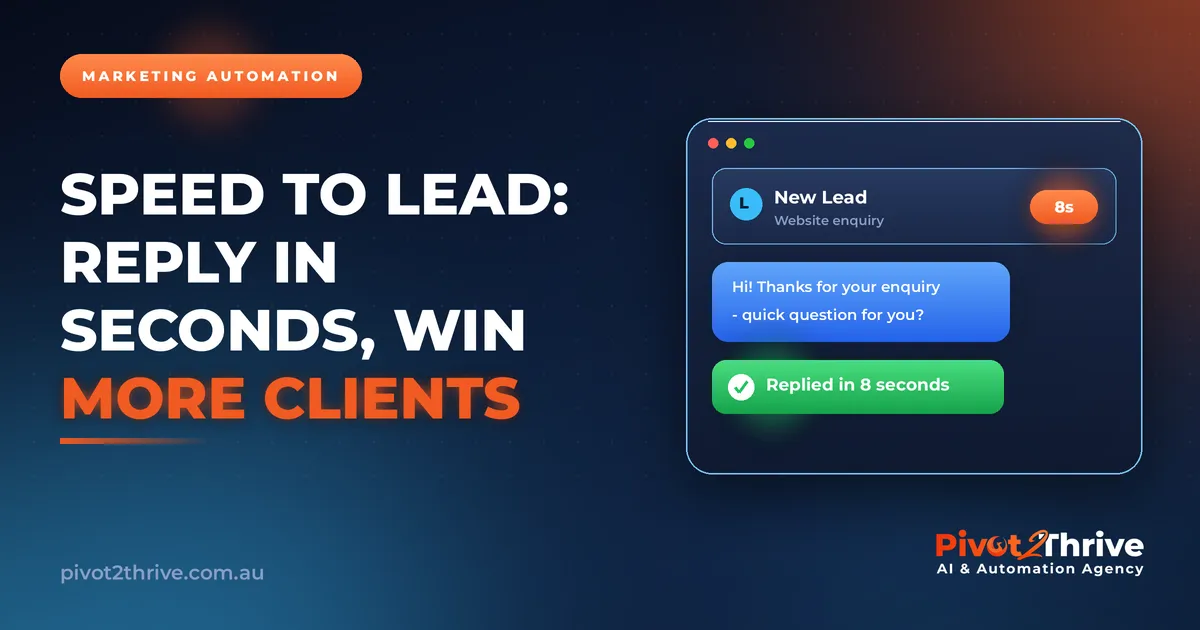
Speed to Lead: Why Replying in Seconds Wins More Clients
Speed to lead — how fast you respond to a new enquiry — is quietly deciding which businesses win and which lose deals they have already paid to generate. You can run brilliant ads and rank well in search, but if a lead waits an hour for a reply, most of that marketing spend is wasted. For Australian businesses competing on the same Google and Meta results, response speed is one of the cheapest and most overlooked levers for more clients.
This guide is written by Dr Priya Jaganathan, a Go High Level Certified Admin, Certified AI Tech Stack Consultant and keynote speaker who builds fast-response lead systems for service businesses across Australia. The aim here is a practical playbook you can implement, not slogans.
Speed to lead is the time between an enquiry arriving and your first genuine response
Speed to lead measures the gap between the moment a prospect raises their hand — a form fill, a call, a message, a booking enquiry — and the moment you make real, useful contact back. It is not about firing off a generic "we'll be in touch" auto-reply. It is about a fast, relevant response that engages the buyer while their intent is still hot. The shorter that gap, the more likely you are to reach them, qualify them and book them before they cool off or contact a competitor. It is a system metric, which means it can be measured, automated and improved.
Why speed to lead matters more than most owners realise
The data is stark. Classic lead-response research found that contacting a web lead within five minutes makes you dramatically more likely to qualify that lead than waiting 30 minutes, and the odds collapse further by the one-hour mark. Yet study after study shows the average business takes far longer than five minutes to respond — often hours. That gap is pure opportunity. If your competitors are slow and you reply in seconds, you win conversations they never even had. The economics are compelling: you are not spending more on advertising, you are simply converting more of the leads you already attract.
How to engineer fast speed to lead with AI and GoHighLevel
Speed to lead breaks when it depends on a human noticing a notification. The fix is to build a system that responds automatically and routes intelligently. Here is the framework.
- 1. Centralise every lead source into one CRM. Web forms, Facebook and Instagram lead ads, Google enquiries, calls and chat should all flow into a single platform such as GoHighLevel. You cannot respond fast to leads scattered across inboxes and tabs.
- 2. Trigger an instant first response. The second a lead arrives, fire an automated SMS and email within seconds. A personalised, conversational message — not a robotic confirmation — keeps the prospect engaged.
- 3. Add an AI conversation to qualify. Layer an AI agent over the first response to answer questions, ask qualifying questions and gauge intent, so hot leads are identified immediately instead of sitting in a queue.
- 4. Book straight into the calendar. Let qualified leads self-book an available time inside the same conversation. Removing the back-and-forth is where most speed is lost.
- 5. Route and escalate to humans with context. When a lead needs a person, notify the right team member instantly with the full conversation, so they pick up where the AI left off rather than starting cold.
- 6. Build relentless follow-up sequences. Most leads do not convert on first contact. Automate multi-step follow-up across SMS, email and call tasks over the following days so no enquiry goes quiet.
- 7. Measure response time and act on it. Track your average speed to lead as a core metric. If it creeps up, find the broken step and fix it. What gets measured gets managed.
Want every lead answered in seconds, automatically? Book a speed-to-lead setup session with Pivot2Thrive here.
An Australian real-world example
Picture a Sydney trades business spending well on Google ads but quoting slowly — enquiries sat until someone had a spare moment, often hours later, and many callers had already booked a competitor by then. After centralising leads into one CRM and adding instant SMS plus an AI qualifier, every new enquiry received a reply within seconds, was asked a few qualifying questions, and was offered a booking or call-back time immediately. Hot jobs were escalated to the owner with full context. Nothing changed about the ad spend — only the response system. The outcome owners notice: more quotes booked from the same number of enquiries, because the business was simply first to respond.
Common mistakes to avoid
- Relying on humans to watch notifications. People are busy, asleep or on a job. Automation is the only way to guarantee a seconds-fast response every time.
- Sending a dead-end auto-reply. "Thanks, we'll be in touch" stalls momentum. The first message should start a real conversation and move toward a booking.
- Leads scattered across channels. If enquiries land in separate inboxes, fast response is impossible. Consolidate everything into one platform.
- Giving up after one or two touches. Persistence wins deals competitors abandon. Automate follow-up over days, not minutes.
- Never measuring response time. If you do not track speed to lead, you cannot improve it. Make it a visible number your team owns.
Frequently Asked Questions
What is a good speed-to-lead response time?
Faster is always better, and under five minutes is the widely cited threshold where conversion odds are strongest. With automation you can respond in seconds, which puts you well ahead of competitors who typically take an hour or more.
Can speed to lead really be fully automated?
The first response and qualification can be, yes. Automated SMS and email fire instantly, an AI agent qualifies and books, and humans step in for high-value or complex conversations with full context. The system guarantees speed; people add judgement where it matters.
Does fast response hurt the customer experience?
The opposite. Prospects increasingly expect immediate answers, and a fast, relevant reply signals that you are organised and easy to deal with. Done well, automation makes the experience feel more responsive, not less personal.
Which leads should I respond to fastest?
All of them, automatically — you rarely know which enquiry is most valuable at first contact. A system that responds to every lead in seconds, then qualifies, ensures you never miss a high-value buyer because they looked ordinary on arrival.
How does GoHighLevel help with speed to lead?
It centralises every lead source into one platform and lets you trigger instant automated responses, AI conversations, calendar bookings and multi-step follow-up from a single system. That consolidation is what makes a seconds-fast, reliable response achievable rather than aspirational.
Win the deals you are already paying for
Speed to lead is the rare growth lever that costs almost nothing and compounds immediately: respond first, qualify fast, book instantly. To build a system that answers every enquiry in seconds, book a session with Pivot2Thrive or learn more at pivot2thrive.com.au.
Related Articles
Related Articles
Marketing Automation
- Speed to Lead: Why Replying in 8 Seconds Wins More Clients
- Speed to Lead: The 60-Second Rule That Wins More Clients
- Speed to Lead: Why Responding in 5 Minutes Wins More Clients
GHL Agency Systems
- How to Write an AI Agency Case Study That Wins Clients (2026 Guide)
- AI Agency Sales Objections: How to Handle the 7 Pushbacks Australian Clients Give (2026 Guide)
- AI Agency Referral Partnerships: How to Get Clients from Accountants, Bookkeepers and Web Designers (2026 Guide)
