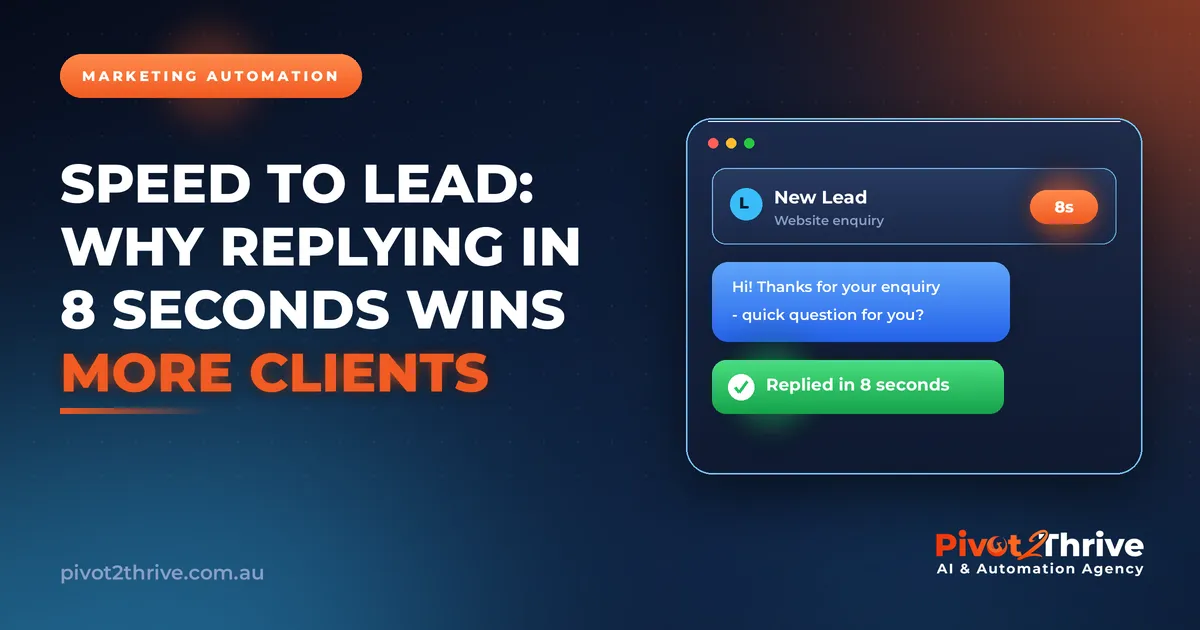
Speed to Lead: Why Replying in 8 Seconds Wins More Clients
Speed to lead is the single biggest predictor of whether a new enquiry turns into a paying client, and most Australian businesses are losing deals because they reply in hours instead of seconds. When a prospect submits an enquiry, they are comparing you against everyone else they contacted. The business that replies first usually wins the conversation, and often the sale, before the competition has even seen the notification. If your follow-up takes 30 minutes, an hour, or until the next morning, you are paying for leads and then handing them to whoever answers faster.
This breakdown comes from Dr Priya Jaganathan, a Go High Level Certified Admin, Certified AI Tech Stack Consultant and keynote speaker who builds automated lead-response systems for service businesses across Australia. The aim is straightforward: explain why response time decides the outcome, and how to engineer a system that replies in seconds without a human watching the inbox.
Speed to lead is the elapsed time between a prospect making an enquiry and your business responding to it
It is measured from the moment someone fills in a form, sends a message, or rings, to the moment they receive a real, relevant reply. The shorter that gap, the higher the chance of a conversation, a qualification, and a booking. Speed to lead is not about being pushy. It is about reaching the prospect while their intent is still hot, before they move on to the next option in the search results.
Most businesses dramatically overestimate how fast they respond. They count "we usually get back same day" as fast. In a market where the prospect contacted four competitors in five minutes, same-day is last place.
Why speed to lead matters more than almost any other sales lever
The data is unambiguous. Research by Dr James Oldroyd found that businesses contacting a lead within five minutes are up to 21 times more likely to qualify that lead than those who wait 30 minutes, and the odds of even making contact drop sharply with every minute that passes. A separate widely cited finding shows that roughly half of buyers choose the vendor that responds first. Yet the average business takes hours to respond to an inbound enquiry, and a large share never follow up at all.
That gap is the opportunity. You do not need more leads to grow; you need to stop wasting the ones you already pay for. A business spending money on Google and Meta ads to generate enquiries, then replying in two hours, is funding its own underperformance. Closing the response-time gap is often the fastest margin improvement available, because the leads are already bought and paid for.
How to build a speed-to-lead system that replies in seconds
Responding in seconds reliably is impossible for a human watching an inbox. It requires a system. Build it in this order.
1. Capture every enquiry into one place. Web forms, Facebook and Instagram leads, Google enquiries, and missed calls must all flow into a single CRM. Leads scattered across separate apps cannot be answered fast because no one is watching all of them at once. Unifying capture is the foundation everything else sits on.
2. Trigger an instant automated first response. The moment a lead arrives, fire an automated SMS and email within seconds: "Thanks for your enquiry, [Name]. Quick question so we can help you fastest, what are you after?" This single step puts you first in the prospect's inbox while competitors are still unaware the lead exists.
3. Use AI to qualify, not just acknowledge. Go beyond an autoresponder. An AI agent can hold a short back-and-forth, ask qualifying questions, gauge urgency, and route hot leads to a human or straight to a booking link. This turns a generic acknowledgement into a real conversation that moves the prospect forward.
4. Add missed-call text-back. When a call goes unanswered, automatically text the caller within seconds. Many prospects prefer texting and will reply rather than redial. This recovers the enquiries that would otherwise vanish into voicemail.
5. Make booking the default next step. The fastest path from enquiry to revenue is a calendar. Once a lead engages, offer a direct booking link so they can self-schedule without waiting for a callback. Removing the back-and-forth removes the points where leads go cold.
6. Build a persistent follow-up sequence. Most sales require multiple touches, yet most businesses give up after one. Automate a sequence of polite follow-ups over several days across SMS and email for leads who do not respond immediately. Persistence, automated, dramatically lifts total conversion.
7. Measure response time as a core metric. Track average time-to-first-response and review it weekly. What gets measured improves. When response time is a number on a dashboard rather than an assumption, it stays fast.
Engineered properly, this system turns a lead arriving at 11pm on a Sunday into a qualified, booked appointment by the time you open your laptop on Monday.
Ready to close the response-time gap in your business? Book a CRM and automation transition call with Pivot2Thrive and we will build the speed-to-lead system around your enquiry flow.
An Australian real-world example
A Sydney home-services business was spending heavily on Google Ads but converting poorly. The owner believed the problem was lead quality. A review of the data told a different story: the average time to first response was just over three hours, and most enquiries arrived while the team was on the tools and unable to answer. The business installed an instant SMS and email response triggered the moment a lead came in, an AI qualifier to handle the first exchange, and missed-call text-back for unanswered calls. Average response time dropped from over three hours to under 30 seconds. Within six weeks, booked jobs from the same ad spend rose noticeably, because the business was now first to respond instead of fourth. The leads had always been good enough; the response time had been costing the deals.
Common speed-to-lead mistakes
Relying on a human to watch the inbox. People sleep, take breaks, and get busy. Seconds-fast response is only possible with automation handling the first touch.
Sending a bland autoresponder and stopping. "We'll be in touch" is not engagement. The first message should start a real conversation and qualify the prospect.
Giving up after one attempt. Most conversions take several touches. A single follow-up leaves the majority of winnable deals on the table.
Ignoring missed calls. A missed call with no text-back is a lost lead. Automating that recovery captures enquiries competitors never see.
Not measuring response time. If you do not track time-to-first-response, you are guessing, and the guess is almost always more optimistic than reality.
Frequently Asked Questions
What is a good speed-to-lead response time?
Under five minutes is the widely cited threshold where qualification rates spike, but the practical target with automation is under one minute. An instant automated first response in seconds, followed by human or AI qualification, beats almost any manual process and consistently puts you ahead of slower competitors.
Does fast automated response feel impersonal to prospects?
Done well, it feels responsive, not robotic. A prompt, relevant message that asks a helpful question reads as attentive service. Prospects are far more likely to be annoyed by silence than by a fast, useful reply that helps them get what they came for.
What tools do I need to build a speed-to-lead system?
You need a CRM that unifies every enquiry channel and supports automation, such as GoHighLevel, plus an AI layer for qualification. The key is that capture, instant response, qualification, and booking all live in one connected system rather than scattered across separate apps.
Will this work for my industry?
Speed to lead improves conversion in any business where prospects enquire and compare options, from trades and medical to real estate, legal, and professional services. Wherever a prospect contacts more than one provider, responding first is a structural advantage.
How quickly can a speed-to-lead system be set up?
A basic instant-response and missed-call text-back setup can be live within days. Adding AI qualification, booking flows, and full follow-up sequences typically takes a couple of weeks to configure and refine around your specific enquiry types.
Win the deals you are already paying for
Speed to lead is not a minor optimisation. It is often the difference between a profitable acquisition channel and a leaking one. The leads are already arriving; the only question is whether you reach them first. Engineer a system that replies in seconds, qualifies automatically, and follows up persistently, and you convert more of the same enquiries without spending another dollar on ads.
To build a response system that wins the first-reply race, book a call with the Pivot2Thrive team or explore more at pivot2thrive.com.au.
Related Articles
- PowerPivot Leads Pro: automated lead capture and follow-up
- AI Receptionist Agent: never miss another enquiry
- More articles from Pivot2Thrive
Related Articles
Marketing Automation
- Speed to Lead: Why Replying in Seconds Wins More Clients
- Speed to Lead: The 60-Second Rule That Wins More Clients
- Speed to Lead: Why Responding in 5 Minutes Wins More Clients
GHL Agency Systems
- How to Write an AI Agency Case Study That Wins Clients (2026 Guide)
- AI Agency Sales Objections: How to Handle the 7 Pushbacks Australian Clients Give (2026 Guide)
- AI Agency Referral Partnerships: How to Get Clients from Accountants, Bookkeepers and Web Designers (2026 Guide)
