
AI Agency Client Health Score: Spot At-Risk Clients Before They Cancel (2026 Guide)
Last updated: November 2026.
 By Dr Priya Jaganathan, Certified AI Tech Stack Consultant · Pivot 2 Thrive · Updated 6 November 2026 · 5 min read
A practical, five-signal scoring system that tells you which AI agency clients are drifting — and what to do about each one this week.
An AI agency client health score is the earliest warning you will get that a retainer is about to walk. Most Australian agency owners find out a client is unhappy when the cancellation email lands, usually a month after the warning signs were sitting in plain sight in the CRM.
This guide shows you how to turn those signs into one number per client, review it weekly, and act on the red ones before the conversation turns into an exit.
Some links below are affiliate links — if you sign up through them, Pivot 2 Thrive may earn a commission at no extra cost to you. It never changes what we recommend.
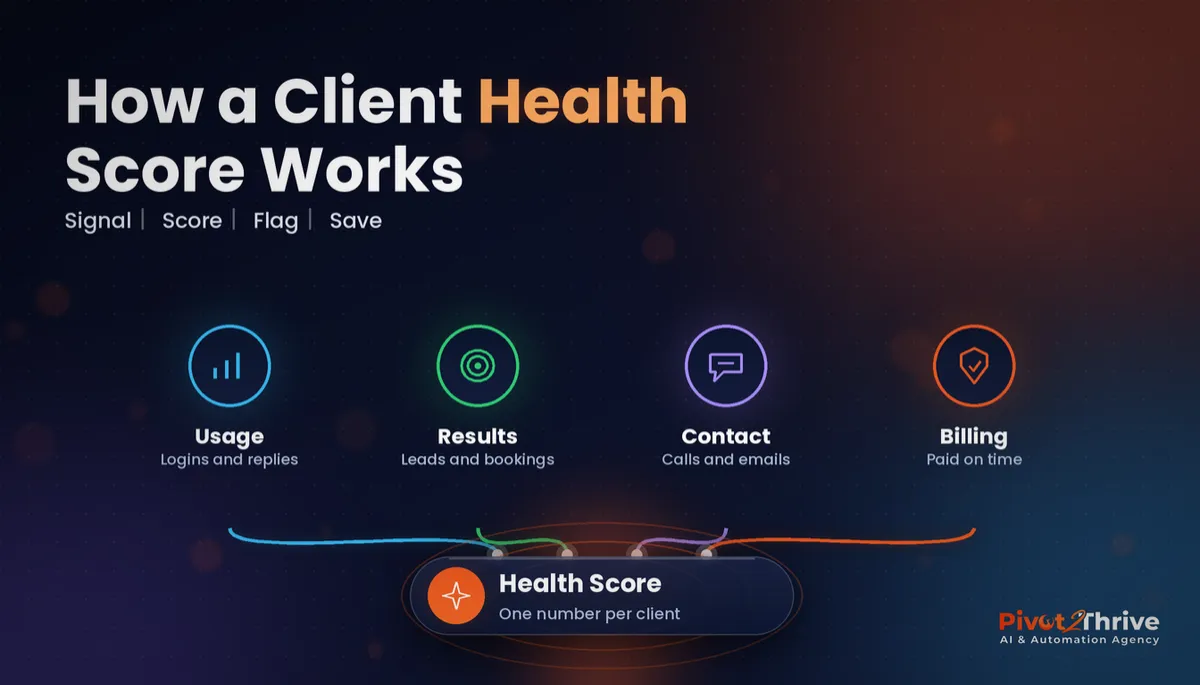
A client health score combines four or five weekly signals — usage, results, responsiveness, billing and sentiment — into one 0–100 number per client. Review it every Monday, treat anything under 60 as at-risk, and run a set save play within 48 hours. It takes about two hours to set up in a spreadsheet or HighLevel pipeline.
I'm Dr Priya Jaganathan — Go High Level Certified Admin, Certified AI Tech Stack Consultant and keynote speaker. At Pivot 2 Thrive I build these systems for Australian businesses every week, so this guide is written from the build, not the brochure.
A client health score is… your churn early-warning system
A client health score is a single number, usually out of 100, that summarises how likely each client is to stay with your agency over the next quarter. It is built from a handful of behaviours you can already see, not from how you feel about the account.
The point is consistency. When every client is measured the same way every week, a slide from 82 to 61 stands out long before anyone says the word "cancel".
It sits alongside the numbers in your weekly AI agency KPIs: KPIs tell you how the agency is going, while the health score tells you how each relationship is going.
Why a health score protects AI agency retention (and your margins)
Retention is where agency profit lives. Bain & Company's long-running loyalty research has shown for decades that small improvements in customer retention produce outsized gains in profit, because a kept client costs nothing to acquire again.
AI retainers are especially exposed. The value is often invisible when it works — a voice agent that quietly books jobs at 9 pm does not send the owner a thank-you note — so clients can forget what they are paying for.
A health score gives you a reason to show up with proof before doubt sets in. Pair it with the monthly report that stops churn and the client sees value on paper and in conversation.
The second benefit is focus. With twenty clients, you cannot give everyone a check-in call every week. The score tells you which three need you now.
How to build an AI agency client health score in 6 steps
This works for agencies with 5 to 60 clients. Budget about two hours for the first build and 20 minutes every Monday after that.
1. Pick four or five signals you can actually measure. Good ones: client logins or app activity, results delivered (leads, bookings, calls answered), how fast the client replies to you, whether invoices are paid on time, and your own one-line sentiment note after every call.
2. Give each signal a weight. Results and responsiveness usually deserve the most weight because they predict renewals best. Keep the total at 100 so the score reads like a percentage.
| Signal | Weight | Green (full points) | Red (zero points) |
|---|---|---|---|
| Results delivered | 30 | On or above the agreed monthly target | Below 50% of target for two weeks |
| Client responsiveness | 25 | Replies within two business days | No reply to two messages in a row |
| Platform usage | 20 | Logs in or works leads weekly | No login for 21+ days |
| Billing | 15 | Paid on time | Invoice 14+ days overdue |
| Sentiment note | 10 | Positive on last call | Complaint or "reviewing budgets" |
3. Score every client on Monday morning. Use a simple sheet or, better, custom fields on the client's contact in HighLevel so the score lives where the team works. Three bands are enough: 80–100 healthy, 60–79 watch, under 60 at-risk.
4. Automate the data you can. Invoice status, last login and lead counts can update automatically through HighLevel workflows and reporting. Leave sentiment manual — a human sentence after each call is worth more than any survey.
5. Attach a save play to each band. Watch clients get a proactive results summary and a quick win within the week. At-risk clients get a call from the owner within 48 hours, a plain review of what is and is not working, and a 30-day fix plan in writing. Having saved GoHighLevel snippets for these check-in messages means nobody has to write them from scratch.
6. Review the score against reality every quarter. Look at who actually left and what their score was eight weeks earlier. If cancelled clients were scoring green, re-weight the signals. The score is a tool, not a verdict.
Done well, the score changes the Monday meeting from "how is everyone going?" to "these three clients need us, here is the plan".
Clients rarely cancel out of nowhere. They go quiet for six weeks first, and a health score is simply the habit of noticing the quiet while you can still fix it.
Not on HighLevel yet? Start with a free 30-day trial — enough time to build everything in this guide before you pay a cent.
An Australian example: a Brisbane AI agency with 22 retainers
Here is an illustrative scenario. A two-person AI agency in Brisbane runs 22 monthly retainers, mostly AI receptionists and lead follow-up for trades and allied health clinics.
They set up five custom fields in HighLevel, one for each signal, plus a formula-driven score in a weekly sheet. A pipeline with three stages — Healthy, Watch, At-risk — shows every client on one board.
In the first month, two clients they considered "fine" dropped into the red: one physio clinic had stopped logging in after the practice manager left, and an electrician's leads had halved because his Google Business Profile had been suspended.
Neither problem was the agency's fault, but both would have ended in a cancellation. A call, a new user login for the replacement manager and help reinstating the profile turned both accounts green within three weeks — and the electrician later took on an upsell to an after-hours voice agent.
Client health score mistakes to avoid
- Tracking too many signals. Twelve metrics turns a two-minute review into a half-day job, and the team stops doing it. Start with five.
- Scoring on gut feel. If the number depends on who fills it in, it is not a score. Write down what green and red mean for each signal.
- Scoring without a play. A red flag nobody acts on is worse than no flag. Every band needs a named owner and a next action.
- Hiding the score from the client entirely. You do not need to show the number, but share the results behind it. Clients who see proof monthly rarely drift into the red.
- Ignoring the healthy clients. Green accounts are your best case studies and referral sources. Ask them while they are happy.
If a client still decides to leave, handle it well — our guide to AI agency client offboarding shows how to exit cleanly and keep the referral.
Frequently Asked Questions
What is a client health score for an AI agency?
A client health score is a single 0–100 number that combines a few weekly signals — results delivered, client responsiveness, platform usage, billing and sentiment — to show how likely a client is to stay. It lets an AI agency spot drifting accounts weeks before a cancellation.
What score means a client is at risk?
A practical rule is 80–100 healthy, 60–79 watch and under 60 at-risk. The exact cut-offs matter less than applying them the same way every week and acting quickly on anything in the at-risk band.
How often should I update client health scores?
Weekly is the sweet spot for most AI agencies. A Monday-morning review takes about 20 minutes for 20 clients once the signals are set up, and weekly is frequent enough to catch a slide before it becomes a cancellation.
Can I build a client health score in GoHighLevel?
Yes. Store each signal in custom fields on the client's contact, use workflows to update billing and activity data automatically, and put clients in a pipeline with Healthy, Watch and At-risk stages so the whole team sees the status at a glance.
Which signal best predicts AI agency churn?
Client responsiveness is often the earliest warning — a client who stops replying is usually already reviewing the spend. Results delivered against the agreed target is the strongest signal overall, so weight those two highest.
Should I tell clients their health score?
You do not need to share the number, but you should share the results behind it in your monthly report. Clients who see regular proof of value are far less likely to drift into the at-risk band in the first place.
Still deciding on a platform? Try HighLevel free for 30 days and build your client health score pipeline before your next Monday review.
Related Articles
Our services
- PowerPivot Leads Pro — AI lead generation and follow-up
- AI Receptionist Agent — answer every call, 24/7
Keep reading
 AI Agency Client Retention: How to Keep Clients Past Month 3
 AI Agency Client Reporting: The Monthly Report That Stops Churn
 AI Agency KPIs: The 8 Numbers I Would Track Every WeekGoHighLevel Snippets: Reply Faster With Saved Messages
Everything else