AI Voice Agent Testing Checklist: What I Test Before a Client Goes Live (2026 Australian Guide)
Last updated: October 2026.
An AI voice agent testing checklist is what separates an agent that books jobs from one that embarrasses your client on its first busy Monday. Most agencies test the happy path a few times, hear a natural voice and go live. Then a real caller mumbles a suburb, interrupts, or asks for a human — and the client's phone becomes your problem.
Key takeaway: Test an AI voice agent in four rounds before go-live: scripted happy-path calls, edge cases (noise, accents, silence, interruptions, unknown questions), human handover, then a soft launch with daily transcript review. Only hand it full call volume once every scenario in the test matrix passes twice.
On This Page
This guide is written by Dr Priya Jaganathan, Go High Level Certified Admin, Certified AI Tech Stack Consultant and keynote speaker, who builds AI and automation systems for Australian businesses and agencies at Pivot 2 Thrive.
What AI voice agent testing is
AI voice agent testing is the structured process of calling an agent the way real customers will, recording what happens, and fixing the prompt, knowledge base and integrations until it behaves reliably.
It is not "I rang it twice and it sounded great". A good test covers what callers say, how they say it, what the agent writes into the CRM and calendar, and what happens when the agent should step aside.
It sits inside your wider delivery QA process — our AI agency delivery QA checklist covers the rest of the build.
Why untested AI voice agents lose clients
Callers are already sceptical. A Gartner survey published in 2024 found that 64% of customers would prefer companies didn't use AI for customer service, and their top concern was that AI would make it harder to reach a person.
That means your agent gets very little benefit of the doubt. One loop where a caller can't get through to a human, one wrong opening hour, one double-booked appointment — and the client hears about it from their customer before they hear about it from you.
Testing is how you protect the retainer. It is far cheaper to find the failure on a test call than in a client's Google review.
The 4-round AI voice agent testing checklist
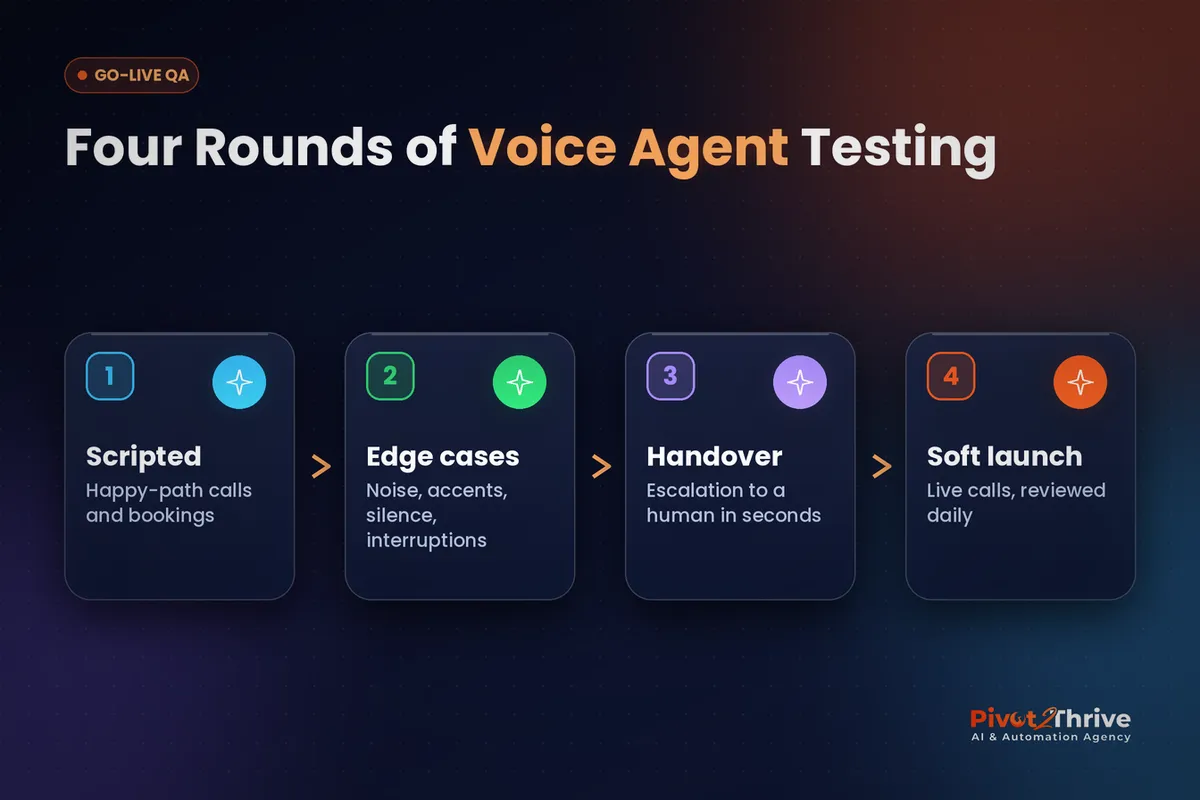
This is the process I use before any client agent takes real calls. Build the test matrix first, then work through the rounds in order.
Round 0 — Build the test matrix. List every reason people call the business: new booking, reschedule, cancel, pricing, location, opening hours, complaint, urgent issue, wrong number. Add the expected outcome for each — booked, message taken, transferred, or politely declined.
Round 1 — Scripted happy-path calls. Call through each scenario exactly as a cooperative customer would. Check the agent's answers against the client's real details, and then check the CRM and calendar: correct contact, correct time, correct tags, confirmation sent.
Round 2 — Edge cases. This is where most agents fail. Test background noise from a car or worksite, strong accents, people who talk over the agent, long silences, spelling of names and email addresses, Australian suburb names, phone numbers read in chunks, and questions that are not in the knowledge base. The right answer to an unknown question is "I don't know, let me take a message" — never a confident guess.
If the agent guesses, the fix is usually in the source material. Our guide to building an AI agent knowledge base that stops wrong answers shows how to structure it.
Round 3 — Human handover. Ask for a person in five different ways, including frustrated ones. Test transfers during business hours and the after-hours fallback. Confirm the human receives the caller's name, number and reason, so the customer never repeats themselves.
Round 4 — Soft launch. Route a share of live calls — after-hours only, or overflow only — to the agent for three to five days. Read every transcript daily, fix patterns, and only then move to full volume.
| Test area | What to test | Pass when |
|---|---|---|
| Accuracy | Hours, prices, services, location, policies | Every answer matches the client's current details |
| Bookings | New, reschedule, cancel; daylight saving and interstate callers | Correct slot in calendar, confirmation sent |
| Speech | Noise, accents, interruptions, silence, spelling | Details captured correctly or confirmed back |
| Unknowns | Questions outside the knowledge base | Agent admits it doesn't know and offers a message |
| Handover | Requests for a human, urgent issues, complaints | Transfer or message within seconds, context passed on |
| Disclosure | Opening line, recording notice | Caller knows it's a virtual assistant and how to reach a person |
| CRM data | Contact fields, tags, pipeline stage, notes | Record is complete and triggers the right follow-up |
Finally, write down what you tested and the results. That document becomes the client's go-live sign-off and your evidence if something goes wrong later.
Want a second pair of eyes on your voice agent before it goes live? Book a call with Pivot 2 Thrive and we will run it through this checklist with you.
An Australian example: a Melbourne dental group voice agent
Consider an agency building an after-hours voice agent for a three-clinic Melbourne dental group.
Scripted tests passed easily. Edge cases did not: the agent struggled with patients spelling surnames, and it confidently quoted a check-up price that differed between clinics. Handover testing showed dental emergencies were being booked into the next available slot rather than routed to the on-call number.
Each fix was small — a spell-back step for names, clinic-specific pricing in the knowledge base, and an emergency keyword rule that transfers immediately. None would have been found by sounding-good testing.
The soft launch ran on overflow calls for four days with daily transcript review before the agent took all after-hours calls. The client's first feedback was about bookings made overnight, not complaints.
If you resell voice agents under your own brand, our white label AI voice agent playbook covers packaging and pricing.
Common AI voice agent testing mistakes
- Only the builder makes test calls. You know the script too well. Get someone else — ideally the client's staff — to call.
- Testing the voice, not the data. A perfect conversation that writes the wrong time into the calendar is a failure.
- No unknown-question tests. If you never ask something outside the knowledge base, you won't know the agent guesses.
- Going straight to full volume. Skip the soft launch and your client's customers become the testers.
- No re-test after changes. Every prompt or knowledge-base edit can break something that used to work. Re-run the core matrix after each change.
Contractors building agents for you? Make this checklist part of your handover standard — see our guide to using contractors without losing quality. And make sure each tester has the right access level using our guide to GoHighLevel user roles and permissions.
Frequently Asked Questions
How long should I test an AI voice agent before go-live?
Plan for at least a week: two to three days of scripted and edge-case testing, then a soft launch where the agent takes a share of live calls and you review every transcript daily. Complex agents with bookings and payments need longer.
How many test calls does an AI voice agent need?
Run every scenario in your test matrix at least twice, with different voices and phones. For a typical small-business receptionist that usually means 40 to 60 calls before the soft launch, then daily review of live calls.
What should an AI voice agent do when it doesn't know the answer?
It should say it doesn't know, offer to take a message or transfer the caller, and never guess. Test this deliberately by asking questions that are not in the knowledge base.
Who should make the test calls?
Use people who did not build the agent, ideally including the client's own staff. Builders unconsciously phrase questions the way the agent expects, which hides real-world problems.
Do Australian time zones affect AI voice agent bookings?
Yes. Queensland, Western Australia and the Northern Territory don't observe daylight saving, while NSW, Victoria, the ACT, Tasmania and South Australia do. Test bookings across the October and April changeovers and for callers in other states.
Should an AI voice agent tell callers it is an AI?
Yes. Being upfront builds trust and avoids complaints. Introduce the agent as a virtual assistant, mention if calls are recorded, and offer a path to a person.
What should I monitor after an AI voice agent goes live?
Track answered calls, completed bookings, transfers to a human, calls where the caller hung up early and any wrong answers in transcripts. Review a sample every week and update the knowledge base when patterns appear.
Ready to launch voice agents your clients trust? Book your call with Pivot 2 Thrive, explore our AI Receptionist Agent, or visit pivot2thrive.com.au.
Related Articles
Our services
Keep reading on the blog
- GoHighLevel User Roles and Permissions (2026 Guide)
- How to Build an AI Agent Knowledge Base in GoHighLevel
- White Label AI Voice Agents in GoHighLevel
- AI Agency Delivery QA: The Checklist That Stops Rebuilds
- AI for Carpet Cleaners in Australia
Everything else
