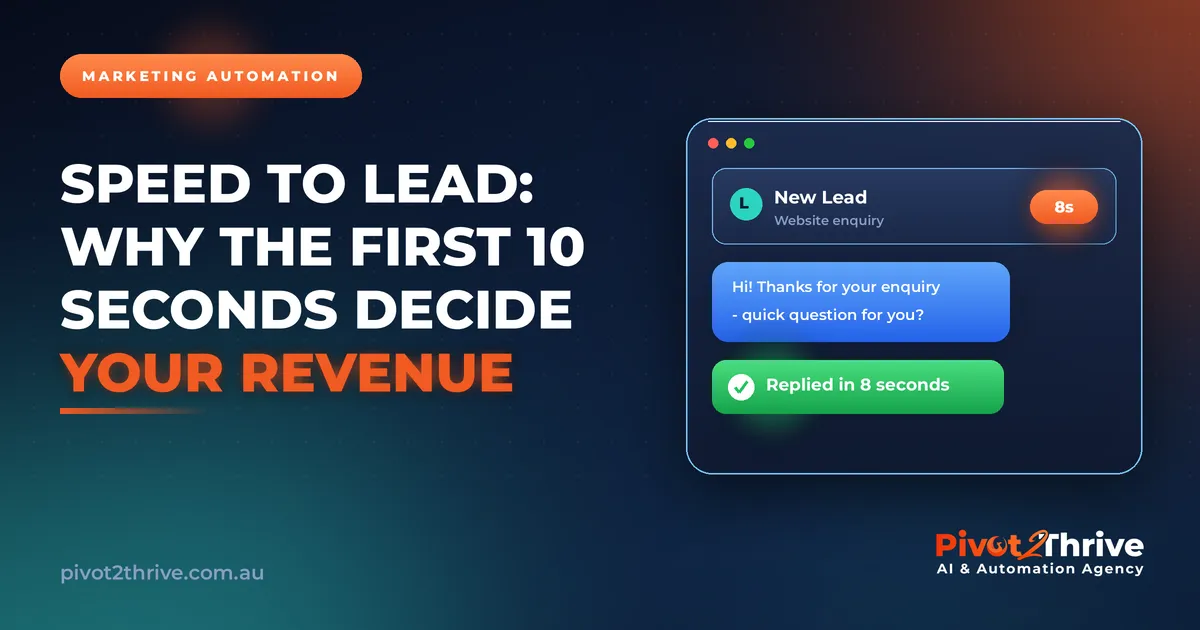
Speed to Lead: Why the First 10 Seconds Decide Your Revenue
Speed to lead automation is the single highest-ROI investment most Australian businesses are not making. Research consistently shows that the first business to respond to an enquiry wins the deal 78% of the time — yet the average response time for Australian service businesses is still measured in hours, not seconds. Every minute of delay is revenue walking out the door.
Dr Priya Jaganathan, Go High Level Certified Admin, Certified AI Tech Stack Consultant, and keynote speaker on AI-powered revenue systems, has deployed speed-to-lead automation for businesses across Australia. The data from these deployments is clear: businesses that respond in under 60 seconds convert at 3-5x the rate of those that take an hour or more.
What Is Speed to Lead?
Speed to lead is the time between when a prospect submits an enquiry — filling out a form, sending a message, making a call — and when your business responds. It is the most critical metric in your sales process because it directly determines how many of your leads become paying customers. A lead that receives a response in 10 seconds is in buying mode. A lead that waits 4 hours has already contacted three competitors and may have already made a decision.
Why Speed to Lead Matters More Than Ever
A Harvard Business Review study found that businesses responding within 5 minutes were 100x more likely to connect with a lead than those that waited 30 minutes. InsideSales.com data shows that 35-50% of sales go to the vendor that responds first. And a Lead Response Management study revealed that contacting a lead within the first minute increases conversion by 391% compared to waiting even two minutes. These are not marginal improvements. This is the difference between a business that grows and one that plateaus despite spending more on advertising. Most businesses focus on generating more leads when the real problem is that they are losing the leads they already have.
How AI-Powered Speed to Lead Automation Works
Instant SMS Response
The moment a lead fills out a form on your website, clicks a Facebook ad, or sends a Google Business message, the system fires an SMS within 10 seconds. This is not a generic "thanks for your enquiry" message. It is a personalised response that acknowledges what they asked about and asks a qualifying question to keep the conversation moving. For example: "Hi Sarah, thanks for your enquiry about teeth whitening at [Practice Name]. Quick question — are you looking for in-chair or take-home whitening? I can get you booked in this week."
AI-Powered Qualification
The AI chatbot continues the SMS conversation, asking the right qualifying questions based on your business criteria. For a trades business, it might ask about job type, location, urgency, and budget range. For a medical practice, it asks about the service needed, preferred time, and whether they are an existing patient. Every response is scored and categorised automatically.
Automated Appointment Booking
Qualified leads are offered available appointment slots directly in the conversation. They can book without calling, without waiting for a callback, and without navigating a complicated online form. The booking syncs to your calendar, sends a confirmation, and triggers a reminder sequence to reduce no-shows.
Intelligent Routing for Hot Leads
High-value or urgent leads trigger immediate notifications to your sales team via SMS, email, or push notification. The system provides full context — what the lead asked about, their qualifying answers, and their contact details — so your team can pick up the conversation seamlessly.
Nurture Sequences for Cold Leads
Not every lead is ready to buy today. Leads that do not book immediately enter an automated nurture sequence — a series of SMS and email messages spaced over days and weeks that provide value, build trust, and re-engage when the timing is right. This recovers 15-25% of leads that would otherwise go cold.
How fast does your business respond to new enquiries? If the answer is anything more than 60 seconds, you are leaving money on the table. Book a speed-to-lead audit with Dr Priya Jaganathan.
Book Your Speed-to-Lead Audit →
Real-World Impact: A Plumber in Sydney Doubles His Bookings
A plumbing business in Western Sydney was spending $3,500/month on Google Ads generating approximately 120 leads per month. Their close rate was 12% — about 14 jobs. The problem was not the ads. It was that their office manager was handling calls, emails, and walk-ins simultaneously, and average lead response time was over 3 hours. We deployed a speed-to-lead system that responded to every form submission and missed call within 10 seconds via SMS, qualified the lead through an AI conversation, and booked urgent jobs directly into the technician's calendar. Within 45 days, same ad spend, same 120 leads — but the close rate jumped to 28%. That is 34 jobs instead of 14 on the same marketing budget. At an average job value of $650, that is an extra $13,000/month in revenue from a system costing $1,200/month.
Common Mistakes With Lead Response
Relying on staff to respond quickly. Even the most dedicated team member gets busy, goes to lunch, or finishes for the day. Human-dependent response systems will always have gaps. AI does not take breaks, does not get overwhelmed, and responds at 2am the same way it responds at 10am.
Sending generic auto-responses. A message that says "Thanks for your enquiry, someone will be in touch soon" does almost nothing. It confirms the lead reached you but does not advance the conversation. Effective speed-to-lead messages are personalised, ask a question, and create forward momentum.
Only following up once. Data shows it takes 6-8 touches to convert a lead. Most businesses follow up once, maybe twice, then move on. An automated nurture sequence handles the persistence that humans forget about or deprioritise.
Not tracking response times. You cannot improve what you do not measure. If you do not know your current average response time, start measuring it today. Most businesses are shocked to discover their actual response time is 5-10x longer than they assumed.
Treating all leads the same. A lead requesting an emergency plumber needs a different response path than someone asking about a bathroom renovation quote. AI qualification and routing ensures the right leads get the right response at the right speed.
Frequently Asked Questions
What is a good speed to lead time?
Under 60 seconds is good. Under 10 seconds is excellent. The data is clear that response times under 5 minutes dramatically outperform anything slower. With AI automation, sub-10-second response times are standard because the system triggers the moment a lead comes in — no human delay, no queue, no business hours limitation.
Does speed to lead work for all industries?
Yes. Any business that generates inbound enquiries benefits from faster response. The impact is largest in competitive service industries — trades, medical, dental, legal, real estate, and financial services — where prospects typically contact 2-3 providers and choose the first one that engages them effectively.
Will leads feel like they are talking to a robot?
Modern AI chatbots are conversational and context-aware. When configured properly with your business knowledge, tone, and processes, most leads cannot tell the difference. And frankly, leads care more about getting a fast, helpful response than about whether a human typed it. A brilliant AI response in 10 seconds beats a mediocre human response in 3 hours every time.
How does speed to lead integrate with my existing systems?
We build speed-to-lead systems on GoHighLevel, which integrates with Facebook Lead Ads, Google Ads, your website forms, Google Business Profile, and most major platforms. Leads from any source are captured in one CRM, responded to instantly, and tracked through your pipeline. If you already use a different CRM, we can typically integrate via API or Zapier.
What does a speed-to-lead system cost?
A complete speed-to-lead system with AI chatbot, SMS automation, appointment booking, and nurture sequences typically costs $1,500-$3,000 to set up and $497-$1,500 per month to run, depending on volume and complexity. For a business converting even 5 additional clients per month at $500+ per client, the ROI is immediate and substantial.
Stop Losing Leads to Slow Response Times
Every hour you wait to fix your lead response time is revenue you will never recover. The leads you lost yesterday are already someone else's customers. Speed to lead is not a nice-to-have — it is the foundation of a profitable sales process.
Book a speed-to-lead audit with Dr Priya Jaganathan at Pivot2Thrive and find out exactly how many leads your current response time is costing you.
Related Articles
Related Articles
Marketing Automation
- Speed to Lead: Why the First 10 Seconds Decide Your Revenue
- Speed to Lead: Why the First 10 Seconds Decide Your Revenue
- Speed to Lead in Australia: Why the First 5 Minutes Decide the Sale (2026)
GHL Agency Systems
- Client Onboarding for AI Agencies: The First 14 Days That Decide Retention
- GoHighLevel SaaS Mode for Australian Agencies: Turn Setups into Recurring Revenue (2026 Guide)
- AI Automation Agency Wollongong: Lead Systems and AI Receptionists for Illawarra Businesses
