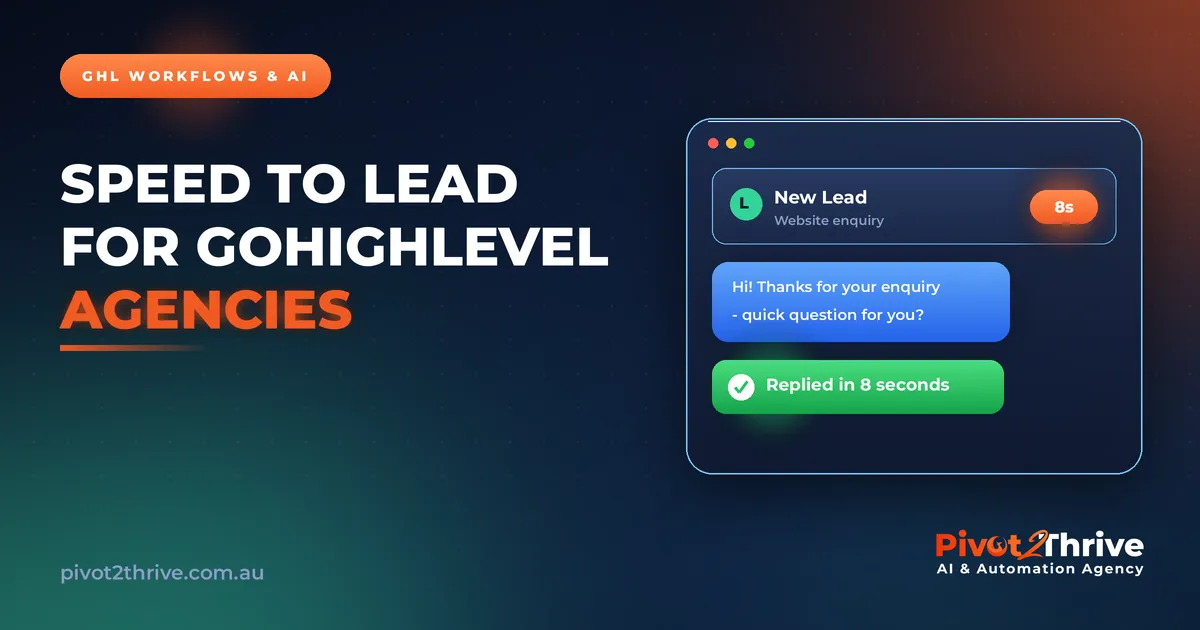
Speed to Lead for GoHighLevel Agencies
Speed to lead is the difference between a GoHighLevel agency that scales and one that stays stuck delivering mediocre client results. If your agency builds funnels and runs ads but lets leads sit before the first reply, you are burning client ad spend and quietly training clients to churn. The single highest-leverage system you can install for every client is instant, automated first response.
Dr Priya Jaganathan runs this playbook inside Pivot2Thrive and the HL Growth Partner network. She is a Go High Level Certified Admin, a Certified AI Tech Stack Consultant, and a keynote speaker on applied AI for agencies. What follows is the exact speed-to-lead system she deploys across client accounts, built entirely in GoHighLevel.
Speed to Lead Is Your Agency's Most Sellable System
Speed to lead is the elapsed time between a prospect submitting an enquiry and your client's business making meaningful first contact. In practice it is the automated engine that fires the instant a lead enters the CRM: an SMS, an email, and increasingly an AI conversation that engages before the lead cools. For a GoHighLevel agency, it is the most sellable system you own because it improves the one number every client cares about, booked appointments, without touching their ad budget.
It is sellable for another reason: it is measurable. You can show a client their old response time, install the system, and show the new one. Few agency deliverables produce a before-and-after that clear, which makes speed to lead both a retention tool and a proof point you can point new prospects at.
Why Speed to Lead Decides Your Client Results
The data is unambiguous. Classic lead-response research found that contacting a web lead within five minutes makes qualification dramatically more likely than waiting even 30 minutes, and after an hour the odds collapse. Yet most small businesses your agency serves take hours to respond, if they respond at all, because a human is watching the inbox between other jobs. That gap is where client ad spend dies.
For your agency, this is the whole game. When a client's leads convert, they stay, they refer, and they increase spend. When leads leak because nobody replied fast enough, the client blames the ads, blames the agency, and churns, even when your funnels and creative were strong. Speed to lead is the system that makes the rest of your work look as good as it actually is. It protects your retention, your reputation, and your recurring revenue in one build.
The Speed-to-Lead Build for GoHighLevel Agencies
Here is the exact system to template once and deploy to every client.
- Step 1 — Consolidate every lead source into one workflow trigger. Facebook lead forms, funnel opt-ins, website forms, and Google enquiries must all fire the same GoHighLevel workflow. If sources are handled separately, some will be forgotten. One trigger, one system.
- Step 2 — Fire an SMS within seconds. The first automated action is a text message, because SMS is opened fastest. Personalise it with the lead's name and reference what they enquired about so it reads human, not robotic.
- Step 3 — Send a parallel email. Immediately follow with an email for leads who prefer it and to reinforce the message. Same speed, second channel.
- Step 4 — Layer an AI conversation agent. Add an AI agent that replies to responses, answers common questions, and qualifies the lead by asking about budget, timeframe, and need, then pushes serious prospects to a booking calendar. This is what turns instant contact into a booked appointment without the client lifting a finger.
- Step 5 — Route booked calls and notify the client. Qualified, booked leads should trigger an instant notification to the client so a human takes over warm. The handoff from automation to person must be seamless.
- Step 6 — Build a persistent follow-up sequence. For leads who do not respond immediately, run a multi-day, multi-channel sequence. Most conversions happen after several touches, and the automation remembers so the client does not have to.
- Step 7 — Template it as a snapshot. Save the entire build as a GoHighLevel snapshot so you deploy it to the next client in minutes, not hours. This is how the system becomes a scalable product line for your agency instead of a one-off custom job.
- Step 8 — Report the numbers monthly. Show each client their response time, reply rate, and booked appointments every month. This is the retention loop: visible results keep clients paying.
Want the snapshot and the client-facing reporting built for your agency? Book a session and we will walk through deploying speed to lead across your accounts: Book your session here.
An Australian Example
A Sydney-based GoHighLevel agency serving trades and home-services clients was fighting churn. Their funnels performed, but clients kept complaining that leads "went nowhere." The real issue was response time: leads landed in client CRMs and sat until a busy tradesperson checked their phone, often hours later. We templated a speed-to-lead workflow, instant SMS and email, an AI qualifier, and a follow-up sequence, then deployed it as a snapshot across the agency's client base. Response times dropped from hours to seconds, booked jobs rose on the same ad spend, and the agency's churn conversation changed entirely. Instead of defending their ads, they were showing clients a booked-appointment graph. The system became their strongest retention tool and a new upsell.
Common Mistakes to Avoid
- Building it custom every time. If you are not templating the workflow as a snapshot, you are trading time for revenue and cannot scale. Build once, deploy many.
- Robotic first messages. A generic "thanks for your enquiry" underperforms. Personalise with name and context so the automation feels like a person.
- No AI qualification layer. Instant contact alone helps, but without qualification your clients still waste time on poor-fit leads. The AI layer is what makes the system premium.
- Forgetting the human handoff. Automation should book the call and hand a warm lead to a human. Systems that never involve a person feel cold and lose deals.
- Not reporting results. If clients cannot see the improvement, they do not value it. Monthly reporting is the difference between a feature and a reason to keep paying you.
Frequently Asked Questions
What is a good speed-to-lead time to aim for?
Under five minutes is the benchmark, and with GoHighLevel automation you can realistically hit under one minute. The goal is to make first contact while the prospect is still on the page or has just left it, which is when they are most receptive.
Can I sell speed to lead as a standalone service?
Yes, and many agencies do. It is a clean, measurable deliverable with an obvious before-and-after, which makes it easy to price as its own recurring service or as the anchor of a retainer. Templated as a snapshot, it carries high margin.
Does the AI qualification replace my client's sales team?
No. It replaces the delay and the repetitive first questions. The AI engages instantly and qualifies, then hands a warm, ready prospect to a human to close. It makes the sales team more effective, not redundant.
How do I deploy this across many clients efficiently?
Build the workflow once, save it as a GoHighLevel snapshot, and load it into each client account. Minor personalisation aside, the core system is identical, which is exactly why it scales as an agency product line.
What if a client's leads come from several different sources?
Route them all into a single workflow trigger. Whether a lead arrives from a Facebook form, a funnel, or a website, the same instant-response system should fire so nothing is missed and every source is handled consistently.
Make Speed to Lead Your Agency's Edge
The agencies that win in 2026 are not the ones with the prettiest funnels. They are the ones whose clients book more calls on the same spend. If you want speed to lead templated and deployed across your accounts, book a session. Learn more about how we help GoHighLevel agencies scale at pivot2thrive.com.au.
Related Articles
Related Articles
GHL Workflows & AI
- How to Build a Lead Generation System That Works 24/7 (Without Chasing Leads)
- AI Lead Generation for Australian Service Businesses: What Actually Works (And What Doesn’t)
- GoHighLevel WhatsApp Automation for Australian Agencies: Setup, Costs and 5 Workflows (2026)
Marketing Automation
- Speed to Lead for GoHighLevel Agencies: Turn Enquiries into Booked Calls in 60 Seconds
- Speed to Lead: Why Australian Businesses Lose Enquiries (2026 Guide)
- Speed to Lead in Australia: Why the First 5 Minutes Decide the Sale (2026)
