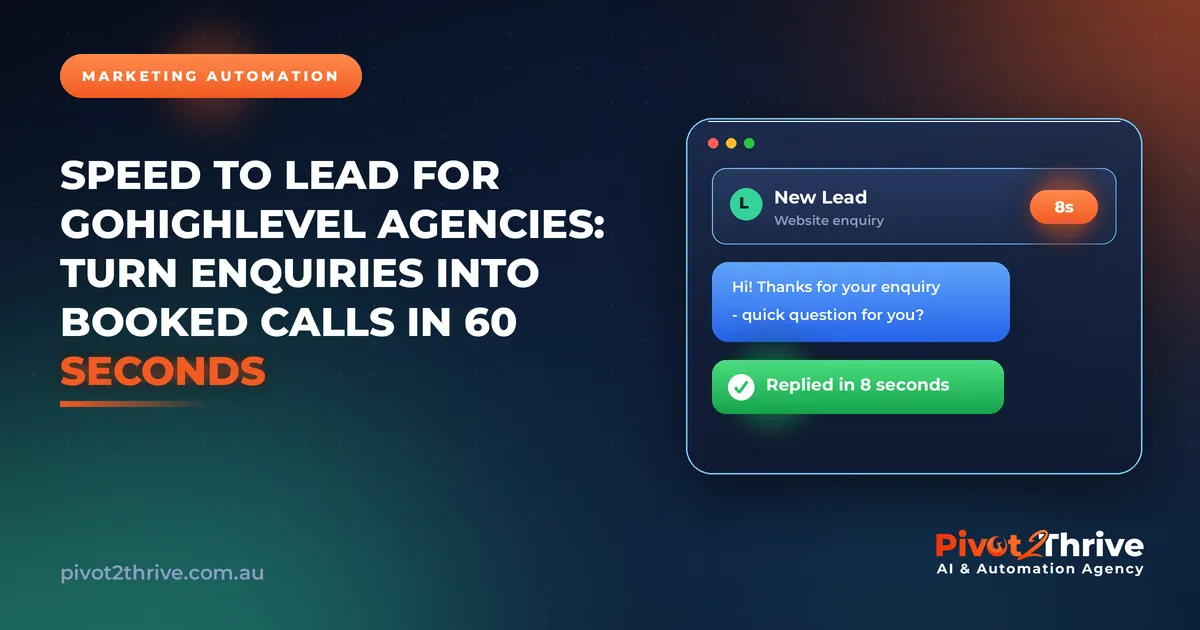
Speed to Lead for GoHighLevel Agencies: Turn Enquiries into Booked Calls in 60 Seconds
Speed to lead is the single highest-leverage metric a GoHighLevel agency can improve for its clients — and most agencies still treat it as an afterthought. A lead that fills in a form is at peak intent for minutes, not days. If your client's first response arrives four hours later, the sale often went to whoever replied in four minutes. This article shows you how to build a sub-60-second response system in GoHighLevel and turn it into your agency's flagship deliverable.
It is written by the team at Pivot2Thrive, led by Dr Priya Jaganathan — Go High Level Certified Admin, Certified AI Tech Stack Consultant and keynote speaker — who builds speed-to-lead systems for Australian agencies and their clients across trades, health, real estate and professional services.
Speed to Lead Is the Time Between Enquiry and First Real Contact
Speed to lead is the elapsed time between a prospect raising their hand — submitting a form, messaging an ad, calling and ringing out — and the moment they receive a genuine, two-way response from the business. Not an auto-receipt email; an actual conversation opener the prospect can reply to. In GoHighLevel terms, it is the gap between the trigger event (form submission, missed call, ad lead) and the first outbound SMS, call or conversational message that starts a dialogue.
The distinction matters because buyers now behave like browsers. They enquire with two or three providers in one sitting, and the first business to hold a real conversation frames the comparison for everyone who follows. Speed doesn't just win the race — it sets the terms of it.
Why Speed to Lead Matters: The Numbers Are Not Subtle
The classic Lead Response Management study made famous by InsideSales and Harvard Business Review found that the odds of qualifying a lead drop dramatically within the first hour, and that responding within five minutes versus thirty minutes improved contact rates by an order of magnitude — roughly 21 times more effective at five minutes than at thirty. Whatever the exact multiple in your niche, the direction is undisputed: response time is the strongest lever on lead-to-appointment conversion that doesn't require spending another dollar on ads.
For agencies, this is a commercial gift. Your clients are already paying for traffic. A speed-to-lead build monetises spend they have already committed — which makes it the easiest ROI story you will ever present.
The Sub-60-Second Build: A Six-Step GoHighLevel Framework
Here is the system we deploy, step by step.
- 1. Centralise every lead source into one pipeline. Connect website forms, Facebook and Google lead ads, chat widgets and missed calls so every enquiry creates a contact and an opportunity in a single GoHighLevel pipeline. You cannot fix response time you cannot see. Tag each lead with its source so reporting stays clean.
- 2. Fire an instant, personal-feeling SMS. Within seconds of the trigger, send a short message from the business owner's local number: first name, acknowledgment, and one easy question — "Hi Sarah, thanks for your enquiry about the kitchen reno. Quick one so I can point you right — is this for your current home?" Questions start conversations; brochures end them. Keep it under 300 characters and write like a human, not a campaign.
- 3. Add missed-call text-back on every client number. When a call rings out, GoHighLevel should text back within seconds: "Sorry we missed you — how can we help?" For trades and clinics this single workflow routinely recovers 20–40% of would-be-lost callers into conversations.
- 4. Layer conversational AI for after-hours and overflow. An AI employee or conversation bot can qualify, answer common questions and book directly into the calendar when the team is off. The handoff rule matters: the moment a human is available, the human takes over, with the full transcript in front of them.
- 5. Book the appointment inside the conversation. Every reply path should lead to a calendar link or a direct AI booking — not "someone will call you". The goal is enquiry-to-booked-call in one thread. Confirmations and reminders by SMS then protect the show-up rate you just earned.
- 6. Report response time as a headline metric. Add median first-response time, contact rate and booked-call rate to your client dashboard. When a client sees "median response: 38 seconds" next to a rising bookings graph, retention conversations become renewals, not negotiations. This is also your sales asset for the next prospect.
Want this running for your agency or your clients without building it from scratch? Book a free strategy call with Pivot2Thrive and we will walk you through the exact workflows.
A Real-World Australian Example
An agency owner we work with runs GoHighLevel for a group of Melbourne mortgage brokers. Before the rebuild, leads from Facebook campaigns were emailed to each broker and followed up "when possible" — median first response was just over five hours, and barely a third of leads were ever contacted. We deployed the framework above: centralised pipeline, instant SMS from each broker's number, missed-call text-back, and after-hours AI qualification feeding a shared calendar. Within six weeks, median response time was under one minute, contact rate had roughly doubled, and booked appointments from the same ad spend were up 64%. The agency turned the dashboard into a case study and used it to sign two more broker groups at a higher retainer than anything they had sold before.
Common Speed-to-Lead Mistakes
- Confusing an auto-responder with a response. "We've received your enquiry" emails start nothing. The first touch must invite a reply.
- Responding fast, then going silent. One SMS is not a system. Build a follow-up sequence across days 1–14; a large share of bookings come from touches three to eight.
- Sending from an unrecognisable number or email-only. SMS from a local number gets read in minutes; email alone gets read eventually, sometimes never.
- Letting the AI hold on to conversations a human should take. Qualify and book with AI, but hand over hot leads instantly — buyers can tell when they're being managed instead of served.
- Not measuring response time at all. If median first-response time isn't on your dashboard, it is almost certainly worse than you think.
Frequently Asked Questions
What is a good speed-to-lead benchmark?
Under five minutes is good, under sixty seconds is where conversion gains get dramatic. With GoHighLevel automation the first SMS should fire within seconds of the enquiry, which makes sub-minute median response an entirely realistic standard for any business, at any hour.
Can GoHighLevel really respond in under 60 seconds?
Yes. Workflow triggers fire in near real-time on form submissions, ad leads and missed calls, and the first SMS typically lands within seconds. The engineering is trivial — the value is in the message design, the follow-up sequence and the booking path that turns a fast reply into a booked appointment.
Won't instant replies feel automated to prospects?
Only if you write them like automations. A short, casual message from a local number asking one relevant question reads as an attentive business, not a bot. Avoid links in the first message, use the prospect's name and reference what they enquired about, and let the conversation flow from their answer.
How should an agency charge for a speed-to-lead build?
Treat it as a productised system: a setup fee (commonly $2,500–$7,500 in the Australian market depending on lead sources and AI scope) plus a monthly retainer for monitoring, optimisation and reporting. Because it converts ad spend the client already pays for, the ROI case is straightforward and the retainer defends itself at review time.
Which industries benefit most from speed to lead?
Any business where enquiries are perishable and comparison shopping is normal: trades and home services, mortgage and finance, real estate, dental and allied health, legal, and high-ticket coaching. If a prospect who isn't answered within the hour books elsewhere, speed to lead is the first system to build.
The First Minute Decides the Deal
Every lead your clients generate is a countdown timer. Build the system that answers before the timer runs out — instant SMS, missed-call text-back, AI after hours, booking inside the conversation, and a dashboard that proves it. If you want it deployed rather than described, book a free strategy session or explore our builds at pivot2thrive.com.au.
Related Articles
- PowerPivot Leads Pro — done-for-you lead generation
- The AI Receptionist Agent that answers every call
- More articles on the Pivot2Thrive blog
Related Articles
Marketing Automation
- Speed to Lead: Why Australian Businesses Lose Enquiries (2026 Guide)
- AI Lead Qualification: Book More Calls From the Same Enquiries
- Speed to Lead: Why Replying in 8 Seconds Wins More Clients
Business Strategy
- The AI Agency Discovery Call Playbook: Turn Enquiries into Signed Clients (2026)
- White-Label AI Services: How Australian Agencies Add Revenue Without Building Tech
- How Much Do AI Agencies Charge? Pricing Models Explained (2026)
