
AI Voice Agent Call Reviews: How I Would QA Client Agents Every Week (2026 Australian Agency Guide)
Last updated: November 2026.
 By Dr Priya Jaganathan, Certified AI Tech Stack Consultant · Pivot 2 Thrive · Updated 21 November 2026 · 7 min read
The weekly call review routine I would run on every client voice agent: what to sample, what to score, and how to turn findings into fixes and retention.
AI voice agent call reviews are the habit that separates agencies whose clients renew from agencies whose clients quietly cancel. A voice agent that was perfect on launch day drifts: prices change, staff leave, new services appear and callers ask questions nobody planned for. If nobody is listening, the client finds out from an angry customer.
This is the weekly QA routine I would put on every client voice agent, built so one person can run it across a full book of clients.
Review a sample of every client's AI voice agent calls each week: all calls that failed to book, all escalations and a random handful of the rest. Score each one on accuracy, outcome, tone and compliance, fix the prompt or knowledge base the same week, and report the improvements to the client.
I'm Dr Priya Jaganathan — Go High Level Certified Admin, Certified AI Tech Stack Consultant and keynote speaker. At Pivot 2 Thrive I build these systems for Australian businesses every week, so this guide is written from the build, not the brochure.
AI voice agent call reviews are…
AI voice agent call reviews are a scheduled quality check where someone at your agency reads or listens to a sample of a client's AI calls, scores them against a simple rubric, and turns what they find into prompt, knowledge base or workflow fixes.
Most voice platforms, including HighLevel's Voice AI, keep call logs with transcripts, recordings and outcomes, so the raw material is already there. The work is in sampling it consistently and acting on it.
Call reviews are the voice-specific part of the delivery QA checklist you run at launch, carried on for the life of the account.
Why weekly voice agent QA protects your retainers
More Australian businesses are now buying AI. The National AI Centre's AI Adoption Tracker reported that 43% of Australian SMEs had some level of AI adoption between December 2025 and February 2026. Those clients are getting more discerning about whether the AI they pay for actually performs.
Voice agents fail quietly. A chatbot error sits in a transcript; a voice agent error is a real customer who hung up, didn't book and never called back. The client rarely hears about it, so the agency rarely does either, until the renewal conversation.
Reviews also give you the story for your monthly report. "We reviewed 40 calls, fixed three answers and booking rate went up" is far stronger than a dashboard screenshot, and it feeds straight into your client health score.
Finally, there's compliance. Recording and disclosure rules apply to every call, and our guide to call recording and consent laws in Australia covers what your agents need to say. Reviews are how you prove they're still saying it.
How to run AI voice agent call reviews in 5 steps
This routine takes about 20 to 30 minutes per client per week once it's set up. Run it on the same day every week so it never slips.
1. Pull the right sample. Don't review calls at random only. Each week, pull every call that ended without a booking or a clear outcome, every call transferred to a human, every call under 30 seconds, plus five random calls that went well. The failures teach you the most; the random calls catch slow drift.
2. Score every call on four things. Use the same rubric every time so results compare week to week.
| Score area | What you check | Typical fix |
|---|---|---|
| Accuracy | Prices, hours, services and policies were stated correctly | Update the knowledge base or prompt |
| Outcome | The caller was booked, transferred or given a clear next step | Adjust booking logic or transfer rules |
| Tone and flow | No interruptions, loops, robotic repeats or awkward silences | Tune the prompt, voice settings or interruption sensitivity |
| Compliance | AI disclosure and recording notice given; no advice outside scope | Fix the opening script and guardrails |
3. Tag every failure with a root cause. Most problems fall into a few buckets: missing information, wrong information, a booking integration fault, a caller question the agent was never designed for, or a prompt that over-talks. Tagging lets you spot patterns across clients, not just within one.
4. Fix it the same week and log the change. Make the smallest change that fixes the problem, test it with a call of your own, and record it in a change log: date, issue, fix, test result. If the fix needs client input, such as new pricing or a policy decision, send one clear question rather than a long report.
5. Report the improvement, not the work. In the monthly report, show calls reviewed, issues found and fixed, and the movement in booking rate or transfer rate. Our monthly client reporting guide shows how to lay that out. If you charge for ongoing care, this routine is the backbone of the support and maintenance plan the client is paying for.
A voice agent is never finished on launch day. The agencies that keep clients are the ones that keep listening.
An Australian example: a Perth agency with eight voice clients
Here is an illustrative scenario. A two-person AI agency in Perth runs voice agents for eight local businesses: dental, physio, trades and a couple of hospitality venues. Launches went well, but two clients cancelled within six months saying the AI "wasn't really working".
They add a Wednesday review block. Each client gets a 25-minute slot: pull the sample, score it in a shared sheet, fix what can be fixed and log it. Anything needing the client goes in one short message.
Within the first month they find a dental agent quoting an old check-up price, a trades agent that couldn't handle callers asking for "today", and a restaurant agent that never mentioned the recording notice. All three are fixed the same week.
The outcome they notice: monthly reports now lead with fixes and booking-rate movement, clients start forwarding odd calls to the agency instead of complaining, and renewals stop being a nervous conversation. If you are pricing this work, our guide to AI voice agent pricing covers how to build it into the retainer.
Voice agent QA mistakes agencies make
- Only reviewing when a client complains. By then, dozens of callers have already had the bad experience. Review on a fixed weekly schedule.
- Listening to random calls only. Most calls go fine. Start with failed bookings, transfers and very short calls, where the problems are.
- Fixing without testing. A prompt change can break something else. Make a test call after every change and note the result.
- No change log. Without a record, you can't show the client the value of the work or roll back a fix that made things worse.
- Hiding the findings. Clients trust agencies that say "we found this and fixed it". Report it.
For a deeper quarterly check of the whole system, pair this weekly routine with our guide on auditing AI automation after 90 days. And if your clients run large outbound or reactivation campaigns, pace them with GoHighLevel workflow drip mode so the agent and the team aren't flooded at once. Seasonal clients such as end-of-lease cleaners are worth extra review time during their peak months.
Frequently Asked Questions
How often should an agency review AI voice agent calls?
Weekly is the right rhythm for most client voice agents, with a quick daily check in the first two weeks after launch. A fixed weekly review catches pricing changes, new caller questions and prompt drift before they cost the client bookings.
Which AI voice agent calls should be reviewed first?
Start with calls that ended without a booking or clear outcome, calls transferred to a human and calls under about 30 seconds, then add a few random successful calls. Failed and short calls show the most problems, while random calls catch gradual drift.
What should an AI voice agent call review score?
Score each call on accuracy of the information given, the outcome for the caller, tone and conversation flow, and compliance such as AI disclosure and recording notices. Using the same four areas every week lets you compare results over time and across clients.
How long does a weekly voice agent call review take?
Once the sample and scoring sheet are set up, a review usually takes about 20 to 30 minutes per client per week. Agencies with many clients batch reviews into one block on the same day each week.
Should agencies charge clients for voice agent call reviews?
Yes, call reviews are ongoing work and belong in a support or maintenance retainer rather than being done for free. Reporting the reviews, fixes and booking-rate changes each month shows the client what that retainer delivers.
How many Australian businesses are using AI?
The National AI Centre's AI Adoption Tracker reported that 43% of Australian SMEs had some level of AI adoption between December 2025 and February 2026. As adoption grows, clients increasingly expect agencies to prove their AI tools are performing.
Related Articles
Our services
- PowerPivot Leads Pro — AI lead generation and follow-up
- AI Receptionist Agent — answer every call, 24/7
Keep reading
 AI Voice Agent Call Recording and Consent Laws in Australia
 AI Agency Delivery QA: The Checklist That Stops Rebuilds
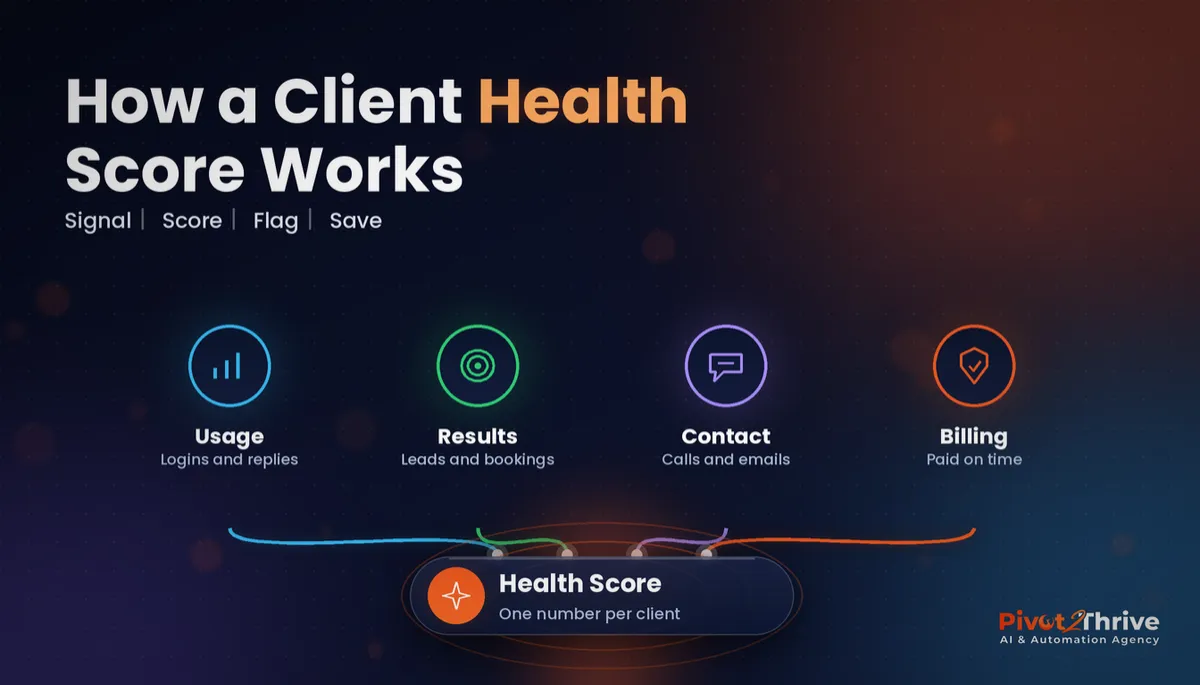 AI Agency Client Health Score: Spot At-Risk Clients Before They Cancel
 AI Voice Agent Pricing: Per Minute or a Flat Monthly Fee?
Everything else