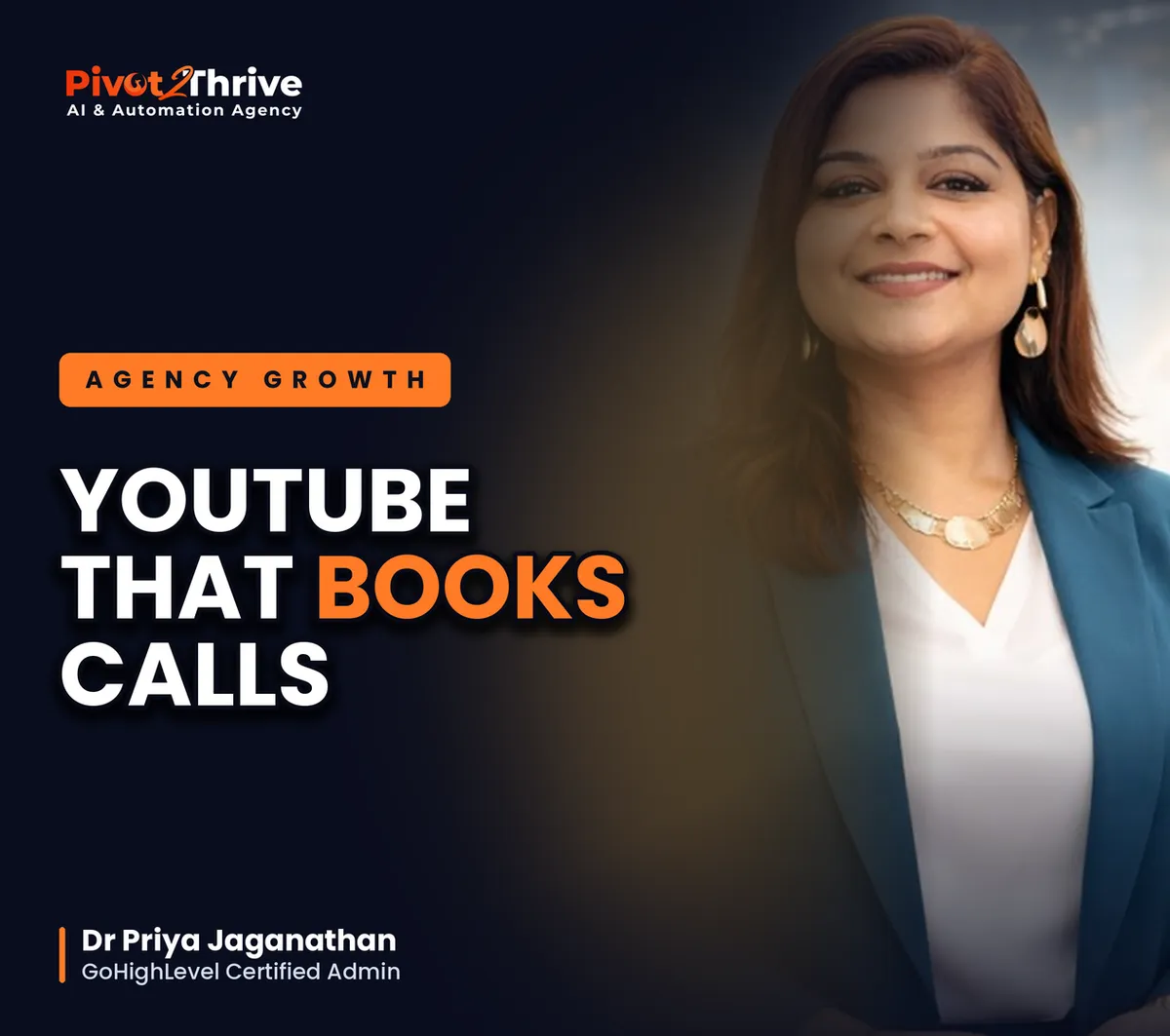
YouTube for AI Agencies: How I Would Use Video to Book Australian Clients (2026 Guide)
Last updated: October 2026.
YouTube for AI agencies is the most underused client channel I see in Australia. Most agency owners post a few screen recordings, get 40 views and quit. The ones who stick with it for six months end up with prospects who book a call already half-sold, because they have watched you explain their exact problem.
Key takeaway: YouTube books AI agency clients when every video answers one question a business owner is already searching, shows the automation working on screen, and ends with one clear next step. Two videos a week for six months, built around a single niche, beats daily posting with no plan.
On This Page
- What YouTube for AI Agencies Really Means (It Is Not Influencer Content)
- Why Video Wins Clients for AI Agencies in Australia
- The 6-Step YouTube Plan I Would Run for an AI Agency
- Turning Your YouTube Library Into a Paid Offer
- An Australian Example: A Physio-Focused AI Agency on YouTube
- 5 YouTube Mistakes That Keep AI Agencies Invisible
- Frequently Asked Questions
- Related Articles
I'm Dr Priya Jaganathan — Go High Level Certified Admin, Certified AI Tech Stack Consultant and keynote speaker. This is the YouTube plan I would run if I were starting an AI agency in Australia today, based on what actually moves Australian service businesses from watching to booking.
What YouTube for AI Agencies Really Means (It Is Not Influencer Content)
YouTube for AI agencies is a search-led video library that answers the questions your ideal clients type before they hire anyone. Think "how do I stop missing calls at my dental clinic" or "what does an AI receptionist cost", not vlogs.
The goal is not subscribers. The goal is booked discovery calls from people who already trust your process.
Every video does three jobs: it ranks for a question, it proves you can build the thing, and it hands the viewer one next step. If a video doesn't do all three, it's a hobby, not marketing.
Why Video Wins Clients for AI Agencies in Australia
Australians are already on the platform. YouTube reaches about 80% of Australian internet users, according to IT Brief Australia's 2025 coverage of local digital usage data, which makes it the broadest-reaching social platform in the country.
AI automation is also hard to explain in text. A 90-second clip of a voice agent answering a real call, booking an appointment and updating the CRM does more selling than a 2,000-word page.
Video compounds. A LinkedIn outreach message is gone in a day, but a well-titled YouTube video can keep bringing enquiries for years, because YouTube and Google both surface it in search.
It also shortens sales calls. When a prospect has watched three of your videos, you skip the "what is AI" part and go straight to scoping.
The 6-Step YouTube Plan I Would Run for an AI Agency
This is the exact sequence I would follow. It's built for a solo founder or a small team doing two videos a week alongside client delivery.
1. Pick one niche and one promise. "AI receptionists for Australian physio clinics" beats "AI for business". A tight niche means every video builds on the last, and the algorithm learns exactly who to show you to. If you haven't chosen yet, start with our guide to choosing an AI agency niche in Australia.
2. Build a list of 30 buyer questions. Pull them from discovery calls, Google's "People also ask" box, YouTube's search suggestions and your own inbox. Sort them into three buckets: problem questions ("why do we miss so many calls?"), solution questions ("how does an AI receptionist work?") and decision questions ("AI receptionist vs answering service").
3. Script for the first 30 seconds. Open by naming the viewer's problem in their words, then say what they'll see by the end. No logo animation, no "hey guys". Show the result on screen early, such as the booked appointment appearing in the calendar.
4. Record demos, not slides. Share your screen and build or run the automation live. Use a sandbox sub-account with realistic Australian data: local phone numbers, suburb names, GST-inclusive prices. Prospects notice when a demo looks American.
5. Give every video one call to action. Mention one lead magnet or one booking link, in the video and pinned in the first comment. A free checklist works well for problem videos; a booking link suits decision videos. Our lead magnet guide for AI agencies covers what to offer.
6. Repurpose every recording five ways. One 10-minute video becomes three Shorts, a LinkedIn post, an email to your list and a section of a blog post. That's how a small team stays consistent without filming every day.
| Video type | Example title | Best call to action | Length |
|---|---|---|---|
| Problem | Why Your Clinic Keeps Missing Calls (And How to Fix It) | Free checklist | 6–10 min |
| Demo | Watch an AI Receptionist Book a Physio Appointment | Book a demo call | 3–8 min |
| Comparison | AI Receptionist vs Answering Service in Australia | Booking link | 8–12 min |
| Case walk-through | How We Set Up Lead Follow-Up for a Brisbane Clinic | Booking link | 10–15 min |
| Short | The 10-second missed-call text that saves jobs | Link to long video | Under 60 sec |
Track three numbers each month: views from search, clicks on your link, and calls booked that mention YouTube. Add a "How did you hear about us?" field to your booking form so you can attribute properly.
Give it at least six months and 50 videos before judging the channel. Most of the enquiries come from the back catalogue, not the newest upload.
Want help building the funnel behind your channel? Book a strategy call with Pivot 2 Thrive and we'll map the lead magnet, follow-up and booking flow your videos should feed.
Turning Your YouTube Library Into a Paid Offer
Once you have 30 or more videos in one niche, you've already recorded most of a training course. Packaging those lessons into a paid membership gives you a low-ticket product for prospects who aren't ready for done-for-you work.
You can host it inside HighLevel and automate access, drip content and renewals — the full setup is in our GoHighLevel memberships and courses guide.
An Australian Example: A Physio-Focused AI Agency on YouTube
Here's how this plays out for a hypothetical two-person agency in Melbourne that sells AI receptionists to allied health clinics.
Month one, they publish eight videos: four problem videos about missed calls and no-shows, three live demos, and one comparison. Each ends with a free "missed call audit" checklist.
By month four, the demo videos are ranking for long-tail searches like "AI receptionist physio clinic". Clinic owners download the checklist, get a three-email follow-up sequence and a booking link.
The sales calls change character. Prospects say "I watched the one where it booked the Saturday appointment" — they arrive asking about price and timeline, not whether AI works. That's the outcome to aim for: shorter sales cycles, not viral views.
They also run a monthly free online workshop and promote it in every video, turning watchers into live attendees.
5 YouTube Mistakes That Keep AI Agencies Invisible
- Talking to other agency owners. Tool tutorials attract peers, not buyers. Make videos for the clinic owner, the tradie and the practice manager.
- Vague titles. "AI Automation Explained" competes with millions of videos. "How Dentists in Sydney Stop Missing After-Hours Calls" competes with almost none.
- No next step. A great video with no link is free education. Always point to one offer.
- Quitting at video 12. Early videos get little traffic. The channel only starts working once there's a library for YouTube to recommend.
- Ignoring follow-up. Leads from YouTube still need fast replies. Route every download into your CRM with an instant SMS and email, the same way you'd handle speed to lead for clients.
Frequently Asked Questions
Is YouTube worth it for a new AI agency in Australia?
Yes, if you commit to one niche and at least six months of consistent publishing. YouTube reaches most Australian internet users and videos keep ranking for years, so the effort compounds. It is a slower channel than outreach, so run it alongside direct prospecting rather than instead of it.
How often should an AI agency post on YouTube?
Two long-form videos a week is a sustainable target for a small team, plus Shorts cut from those recordings. Consistency matters more than volume. One video a week for a year beats daily posting for a month.
What videos should an AI agency make first?
Start with demo videos that show your core automation working, such as an AI receptionist booking an appointment. Then add problem videos that answer the questions prospects ask on discovery calls, and comparison videos for buyers who are close to deciding.
Do I need expensive equipment to start?
No. A decent USB microphone, natural light and free screen-recording software are enough. Clear audio matters far more than camera quality, and most AI agency videos are screen demos anyway.
How do I track whether YouTube is bringing in clients?
Add a 'How did you hear about us?' field to your booking form, use a dedicated link in each video description, and tag those contacts in your CRM. Review search views, link clicks and booked calls monthly.
Should I show my face in AI agency videos?
It helps. Buyers hire people they trust, and a short on-camera intro before the screen demo builds that trust quickly. If you are camera-shy, start with voice-over demos and add face-to-camera intros once you are comfortable.
Ready to turn viewers into booked calls? Book a call with Pivot 2 Thrive and we'll build the lead capture, CRM and follow-up system behind your content. See how we work at pivot2thrive.com.au.
Related Articles
Services
- PowerPivot Leads Pro: AI lead generation and follow-up
- AI Receptionist Agent: answer every call, 24/7
Keep reading
- Podcast Guesting for AI Agencies: How I Would Use Podcasts to Book Clients
- LinkedIn Outreach for AI Agencies in Australia
- Lead Magnets for AI Agencies: What I Would Offer Australian Business Owners
- How to Demo an AI Voice Agent to Australian Clients
- GoHighLevel Memberships and Courses: Turn Your Know-How Into Recurring Revenue
Everything else
