AI for Air Conditioning Businesses in Australia: Book More Jobs Through the Summer Rush (2026 Guide)
Last updated: October 2026.
AI for air conditioning businesses solves the problem every Australian HVAC owner knows: the phone rings hardest on the hottest days, exactly when your techs are in roof cavities and your office can’t keep up. Every unanswered call in a heatwave is a customer ringing the next installer on Google.
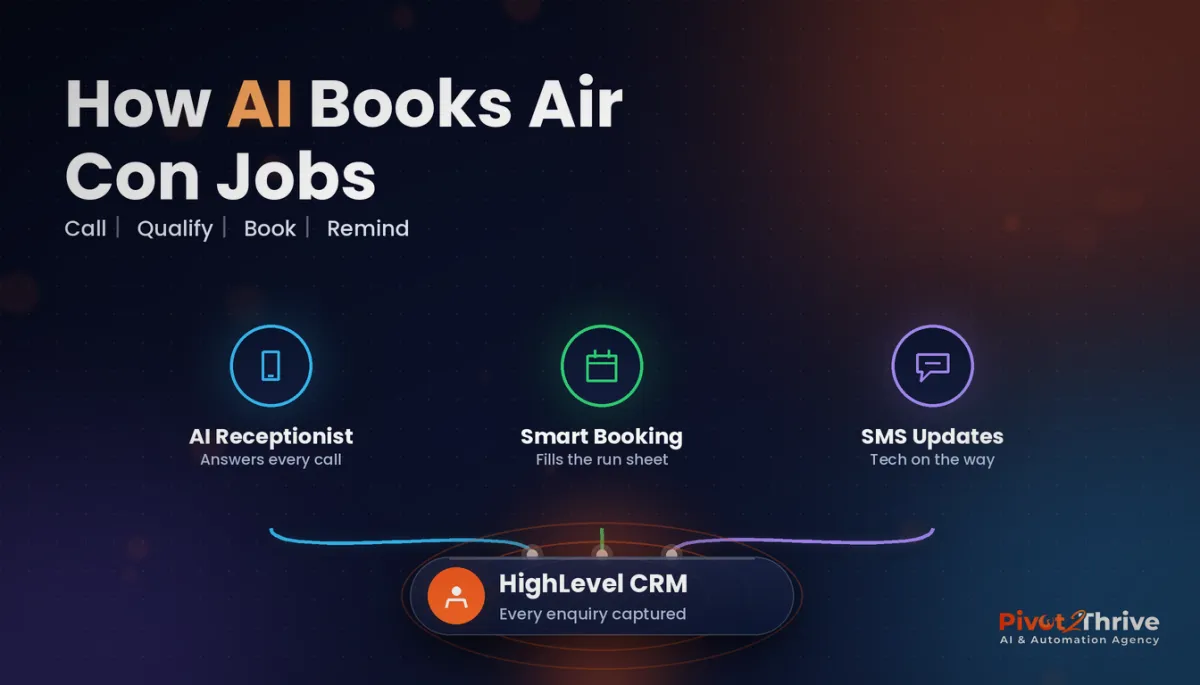
Key takeaway: an AI receptionist connected to your CRM answers every call and message, qualifies the job (install, repair or service; brand; urgency; suburb), books it into the right tech’s run sheet and sends SMS updates. Your team spends summer on the tools while the system captures demand you would otherwise lose.
On This Page
- What Is AI for Air Conditioning Businesses?
- Why Australian Air Con Businesses Lose Jobs in Heatwaves
- How to Set Up AI for Your Air Conditioning Business (8 Steps)
- An Australian Example: Saturday Heatwave, Full Monday Diary
- Five Mistakes Air Con Businesses Make With AI
- Frequently Asked Questions
- Related Articles
This guide is written by Dr Priya Jaganathan, founder of Pivot 2 Thrive, Go High Level Certified Admin, Certified AI Tech Stack Consultant and keynote speaker, who builds and audits AI automation systems for Australian service businesses and agencies every week.
What Is AI for Air Conditioning Businesses?
AI for air conditioning businesses is a set of connected tools that handle the front office: a voice agent that answers calls, a chat and SMS assistant for website and Google enquiries, online booking tied to your calendar, and automated reminders for servicing.
It is not a robot diagnosing a faulty compressor. The AI collects the facts — what the unit is doing, how old it is, whether the home has vulnerable occupants — and hands a clean job to your licensed technicians. The diagnosis stays with people who hold the refrigerant handling licence.
Think of it as a front desk that never takes lunch, never gets flustered by the 4pm heatwave rush and never forgets to call back.
Why Australian Air Con Businesses Lose Jobs in Heatwaves
Demand for cooling is climbing, and it arrives in spikes. According to the Bureau of Meteorology and CSIRO’s State of the Climate 2024 report, Australia has warmed by 1.51 °C since national records began in 1910, and that warming has increased the frequency of extreme heat events.
For an air con business, extreme heat means dozens of calls arriving in the same two or three days. A small office can answer a handful at a time. The rest hit voicemail, and most callers in a hot house don’t leave messages — they ring the next result.
Speed wins these jobs. We explain the mechanics in why replying in seconds wins more clients, but for HVAC the rule is simple: whoever answers first usually books the job.
How to Set Up AI for Your Air Conditioning Business (8 Steps)
This is the system we set up for trades businesses, adapted for air conditioning. Build it in this order.
1. Map your job types and service area. List the jobs you actually want — split installs, ducted, breakdowns, servicing — and the suburbs you cover. The AI can only route what you define.
2. Put a voice agent on overflow and after-hours. Start with calls your team can’t reach: after 5pm, weekends and when every line is busy. The agent answers in your business name, qualifies the job and books it. Our guide to AI voice agents for trades businesses covers the script structure.
3. Write qualifying questions per job type. Use the table below. Good questions save your techs a wasted trip and let you quote installs accurately.
| Job type | What the AI asks | What happens next |
|---|---|---|
| Breakdown / no cooling | Unit type, age, error code, vulnerable occupants, suburb | Urgent slot offered; on-call tech notified by SMS |
| New split or ducted install | Room sizes, property type, existing system, budget range | Site quote booked; prep checklist texted |
| Annual service | Number of units, last service date, access notes | Booked into a quiet-day route; reminder set for next year |
| Warranty question | Brand, install date, invoice number | Logged to the job record; office calls back same day |
4. Connect booking to real availability. The AI should only offer slots your techs can reach, grouped by area so the run sheet makes sense. Block buffer time for travel and roof work.
5. Add a missed-call text back. If a call still slips through, the customer gets a text within seconds offering to book. It is the cheapest safety net in the build — see how missed call text back works.
6. Send “tech on the way” updates. An SMS when the tech leaves the previous job cuts “where are you?” calls dramatically and makes a small business feel organised.
7. Automate service reminders before the season. In late winter and early spring, remind past customers that their system is due for a service. You fill quiet months and spot failing units before the January rush. Keep these messages compliant — our sibling guide on SMS marketing and the Spam Act explains consent and opt-outs.
8. Ask for the review when the job closes. A short text after a completed install with a direct Google review link builds the proof that wins the next summer’s searches.
Want this running before summer peaks? We build and test the full call-to-booking system for Australian trades businesses. Book a strategy call with Pivot 2 Thrive.
An Australian Example: Saturday Heatwave, Full Monday Diary
Here is a typical scenario we map out with HVAC owners: a three-van split-system installer in Western Sydney, owner on the tools, one part-time office manager.
On a 40-degree Saturday, calls arrive faster than anyone can answer. With the system in place, the voice agent picks up every overflow call, separates breakdowns from install quotes and books breakdowns into the on-call tech’s afternoon by suburb.
Install enquiries get a Monday site-quote slot and an SMS asking for photos of the room and switchboard. Monday starts with a full quote diary instead of a voicemail backlog. In spring, the same database receives service reminders, so the vans stay busy in the shoulder season too.
Electricians face the same pattern — compare it with our guide to AI for electricians.
Five Mistakes Air Con Businesses Make With AI
1. Letting the AI diagnose faults. Keep it to fact-finding. Technical advice and refrigerant work belong with licensed techs.
2. Offering slots you can’t meet. If the calendar ignores travel and job length, the AI books a promise your team breaks. Sync real availability.
3. Ignoring vulnerable customers. Elderly residents or babies in a hot house need a fast escalation path to a human. Script it in.
4. Switching it on in December. Build and test in winter. A heatwave is the worst time to debug a booking flow.
5. Forgetting the off-season. Service reminders and heating checks keep revenue steady when cooling demand drops.
Frequently Asked Questions
Can an AI receptionist book air conditioning jobs?
Yes. An AI receptionist can answer calls and messages, ask qualifying questions about the unit and the problem, and book the job into a technician’s calendar based on real availability and service area.
Will customers know they are speaking to AI?
You should tell them. A short line such as “I’m the virtual assistant for the business” builds trust, and most callers care more about getting booked quickly than who answers.
Can the AI give technical advice on a faulty air conditioner?
It shouldn’t. The AI collects the facts, such as error codes, unit age and symptoms, and passes them to a licensed technician. Diagnosis and refrigerant work stay with qualified people.
How much does AI cost for a small HVAC business?
Costs depend on call volume and how much of the system you build, typically a setup fee plus a monthly platform and usage cost. Compare it with the value of the jobs currently going to voicemail during peak season.
When should an air conditioning business set up AI?
Before the cooling season. Building and testing during winter means the system is proven before the first heatwave, when call volumes spike and mistakes are expensive.
Does AI help outside summer?
Yes. Automated service reminders, heating checks and review requests keep the diary full in quieter months and build a customer list you can contact before the next peak.
Summer always brings the calls. The question is whether they turn into booked jobs or someone else’s revenue. Book a call with Pivot 2 Thrive to map your air con business’s booking system, or explore more at pivot2thrive.com.au.
Related Articles
Services
Keep reading
- AI Voice Agents for Australian Trades Businesses
- Missed Call Text Back: The Easiest Automation to Set Up
- Google Review Automation: Get More Reviews on Autopilot
- SMS Marketing and the Spam Act: Compliance Rules
Everything else
