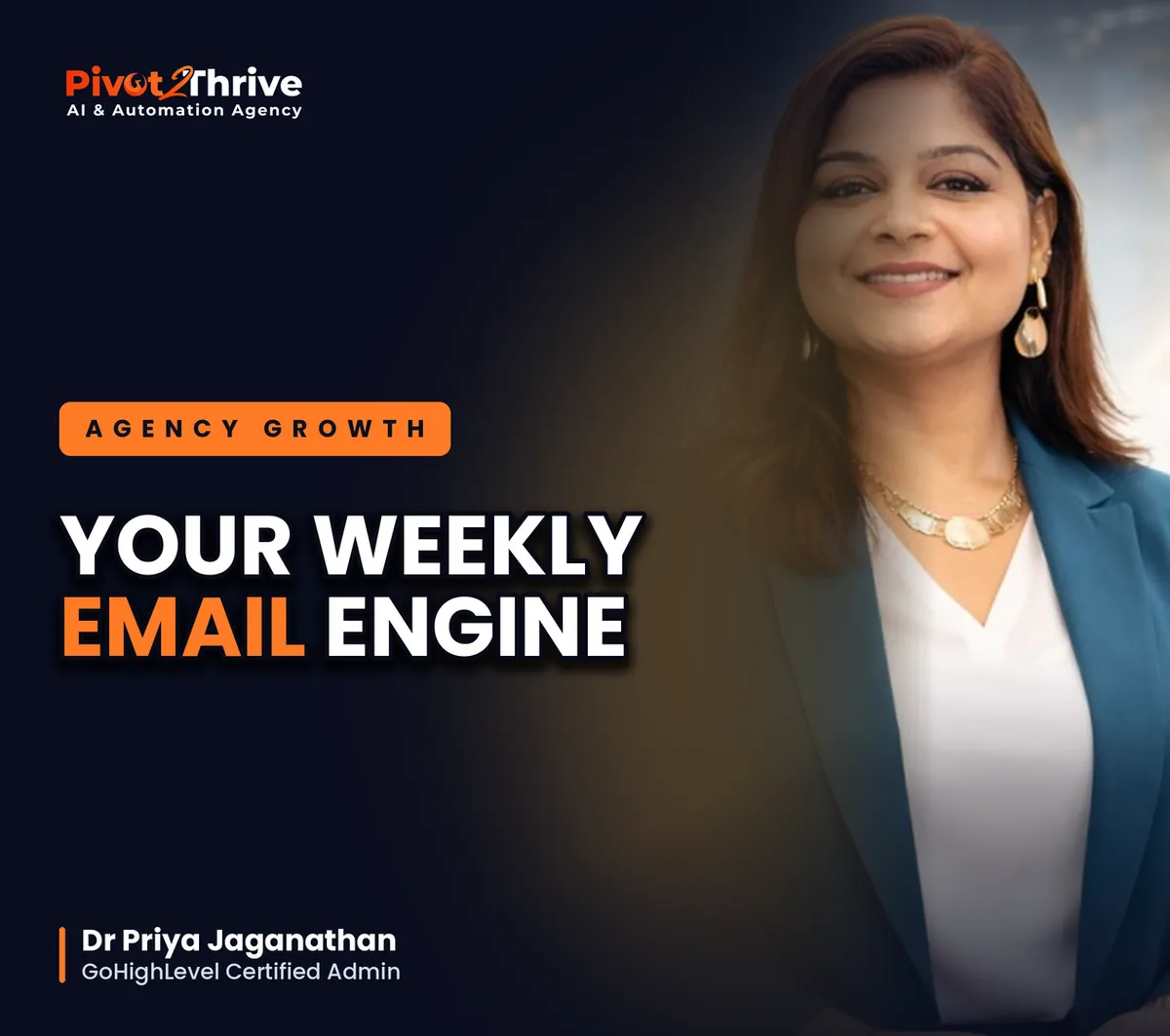
Email Newsletters for AI Agencies: How I Would Use a Weekly Email to Book Australian Clients (2026 Guide)
Last updated: October 2026.
An AI agency email newsletter is the most underrated client-getting asset an Australian agency owner can build. Most agencies chase new leads every week and forget the hundreds of people who already raised their hand once.
If I were starting again, a simple weekly email would be the first marketing system I built after my offer. Here is exactly how I would run it.
Some links below are affiliate links — if you sign up through them, Pivot 2 Thrive may earn a commission at no extra cost to you. It never changes what we recommend.
Key takeaway: An AI agency email newsletter is a short weekly email to opted-in business owners in one niche, sharing one real build, one result and one clear next step. Run it from your CRM, ask readers to reply, and measure discovery calls booked rather than opens.
On This Page
- What an AI Agency Email Newsletter Actually Is
- Why a Weekly Email Still Wins AI Agency Clients in 2026
- How I Would Build an AI Agency Newsletter, Step by Step
- An Australian Example: A Newsletter for Allied Health Clinics
- Common AI Agency Newsletter Mistakes to Avoid
- Frequently Asked Questions
- Related Articles
This guide is written by Dr Priya Jaganathan, Go High Level Certified Admin, Certified AI Tech Stack Consultant and keynote speaker on AI for Australian business. She builds AI and automation systems for Australian service businesses through Pivot 2 Thrive, so what follows comes from real builds, not theory.
What an AI Agency Email Newsletter Actually Is
An AI agency email newsletter is a short, regular email sent to business owners who have opted in to hear from you. It shares one useful idea, one real example and one clear next step.
It is not a company update. Nobody wants to read that you attended a conference or hired a VA. They want to know what AI can do for a clinic, a trade business or an accounting practice this month.
Think of it as a weekly proof-of-competence letter. Every issue shows a prospect that you understand their problem before they ever book a call.
Why a Weekly Email Still Wins AI Agency Clients in 2026
Most buyers of AI services are not ready on day one. They download a lead magnet, watch a talk or connect on LinkedIn, then go quiet for months. A newsletter keeps you in the room until the timing is right.
The return can be strong when it is done properly. In Litmus's State of Email report (2025), 35% of marketers surveyed said they get $10 to $36 back for every $1 spent on email, 30% reported $36 to $50, and 5% reported more than $50. It is a survey of marketers rather than agencies, but it shows why email sits at the centre of most serious marketing stacks.
The market is big enough to justify the effort. The ABS's Counts of Australian Businesses release (August 2026) recorded 2,814,778 actively trading businesses at 30 June 2026. You only need a few hundred of the right ones on your list.
Email also compounds with everything else you do. Each AI agency lead magnet and every talk you give feeds the same list, so your marketing stops resetting to zero each month.
How I Would Build an AI Agency Newsletter, Step by Step
This is the system I would set up in the first fortnight. It is deliberately simple, because a newsletter that ships every week beats a beautiful one that ships twice.
1. Pick one reader, not everyone
Write for one niche, such as allied health practice owners or trade business owners. A newsletter for "small businesses" reads like nobody's newsletter. If you have not chosen yet, start with the niche you already have one client in.
2. Get consent the Australian way
Under the Spam Act 2003, commercial emails need consent, must identify who sent them and must include a working unsubscribe. Use a clear opt-in form, never import scraped lists, and keep a record of where every subscriber came from. The same rules apply to SMS, which I cover in the Spam Act guide for GoHighLevel SMS.
3. Use a fixed five-part format
A fixed format means you never stare at a blank page. I would use the same five blocks every week:
- One observation from client work this week (anonymised).
- One build: a workflow, prompt or automation explained in plain English.
- One number: a result, a time saving or a response-time change you measured.
- One question readers can reply to.
- One call to action: book a call, grab a resource or reply with a keyword.
4. Set up the list and automation in your CRM
I would run the whole thing inside GoHighLevel so subscribers, conversations and bookings live in one place. Build the opt-in form, tag new subscribers by source and send a three-email welcome sequence. My GoHighLevel email campaigns guide walks through the build.
Before your first send, authenticate your sending domain. The email deliverability guide covers SPF, DKIM and DMARC in plain terms.
5. Turn replies into conversations
The reply is the real conversion, not the open. Ask a simple question each week, such as "What is the one task your front desk hates?" Every reply lands in your inbox as a warm conversation you can move toward a discovery call.
6. Measure what matters
Ignore vanity metrics. Track four numbers each month and you will know whether the newsletter is working:
| Metric | What it tells you | What I would aim for first |
|---|---|---|
| Replies per issue | Whether the content starts conversations | At least a few per issue |
| Discovery calls from email | Whether the CTA is clear | One or more a month |
| Unsubscribes per issue | Whether you are writing for the right reader | Low and steady |
| Clicks on the main link | Whether the build or resource is useful | Trending up over a quarter |
These are working targets, not industry benchmarks. Set your own baseline after the first eight issues and improve from there.
7. Repurpose one issue into a week of content
Each newsletter becomes a LinkedIn post, a short video and a talking point for sales calls. I explain the video side in YouTube for AI agencies. One piece of thinking, used five times.
Want help building a newsletter, opt-in and follow-up system that books calls while you deliver client work? Book a free strategy call with Pivot 2 Thrive.
Not on HighLevel yet? Start with a free 30-day trial — enough time to build everything in this guide before you pay a cent.
An Australian Example: A Newsletter for Allied Health Clinics
Picture a two-person AI agency in Brisbane that serves physiotherapy and podiatry clinics. They publish one email every Tuesday morning called "The Front Desk Fix".
Each issue covers one problem: missed calls during treatment sessions, no-shows, slow recall bookings. They show the workflow, link a short demo and end with "Reply SETUP and I will show you how this works for your clinic." Many of those replies turn into conversations about an AI receptionist agent or a missed-call follow-up build.
This is an illustrative scenario rather than a named client, but it reflects the pattern I see: specific problems, plain language, one easy reply.
Common AI Agency Newsletter Mistakes to Avoid
- Writing about AI news instead of client problems. Business owners care about missed calls, not model releases.
- Sending only when you remember. Pick a day and protect it; consistency is the whole strategy.
- Burying the call to action. One clear ask per issue, placed where a skimmer will see it.
- Ignoring consent. Buying or scraping lists breaks the Spam Act and wrecks your sender reputation.
- Making it too long. Three to five minutes of reading is plenty for a busy owner.
Frequently Asked Questions
How often should an AI agency send a newsletter?
Weekly is the sweet spot for most Australian AI agencies. It is frequent enough to stay top of mind and manageable alongside client delivery. Fortnightly is fine if you can keep the quality high and the day consistent.
How many subscribers do I need before a newsletter is worth it?
You can start with fewer than 100 subscribers. A small list of the right business owners in one niche will book more calls than a large generic list. Focus on relevance first and growth second.
What should an AI agency newsletter include?
Use a fixed format: one observation from client work, one build explained in plain English, one measured result, one question to reply to and one call to action. The fixed format makes it fast to write every week.
Do Australian email newsletters need consent?
Yes. Under the Spam Act 2003, commercial emails need the recipient's consent, must identify the sender and must include a working unsubscribe option. Use an opt-in form and never import scraped or purchased lists.
Which tool should I use to send an agency newsletter?
Any reputable email platform works, but running it inside your CRM keeps subscribers, replies and bookings in one place. Many Australian AI agencies use GoHighLevel because email, SMS, forms and calendars sit in one system.
How do I turn newsletter readers into clients?
Ask for replies, not just clicks. A simple question or a reply keyword starts a real conversation, and from there you can offer a discovery call. Track discovery calls booked from email as your main success metric.
Ready to turn your list into booked discovery calls? Book a free strategy call with Pivot 2 Thrive.
Learn more about how we help agencies and service businesses at Pivot 2 Thrive. Building it yourself? Try HighLevel free for 30 days and set up your first welcome sequence this week.
Related Articles
Pivot 2 Thrive services
- PowerPivot Leads Pro — AI lead generation and follow-up
- AI Receptionist Agent for Australian businesses
Keep reading on the blog
- Lead Magnets for AI Agencies
- Cold Email for AI Agencies in Australia
- GoHighLevel Email Campaigns: Nurture Leads Until They Book
- AI for Handyman Businesses in Australia
- GoHighLevel IVR: Route Every Call to the Right Person
Everything else
