
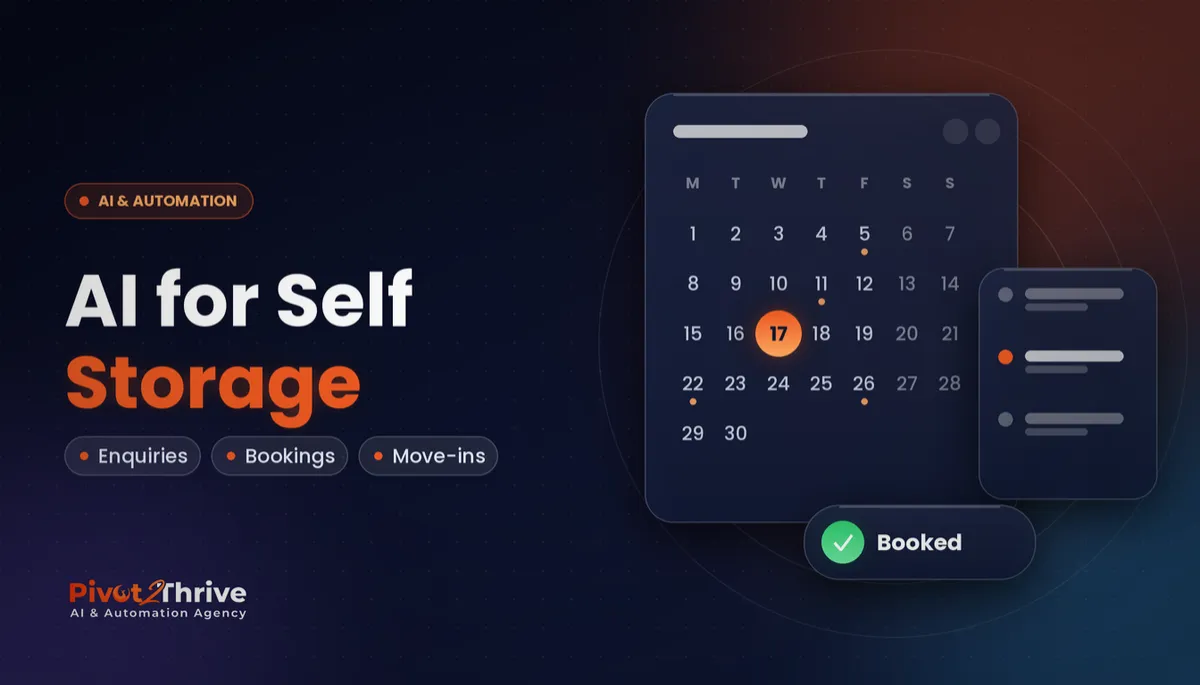
AI for Self Storage Businesses in Australia: Answer Every Unit Enquiry Through the Summer Moving Rush (2026 Guide)
Last updated: November 2026.
 By Dr Priya Jaganathan, Certified AI Tech Stack Consultant · Pivot 2 Thrive · Updated 14 November 2026 · 7 min read
How an independent storage facility can answer every call, chat and web enquiry — even when the office is shut or the manager is out on the yard.
AI for self storage businesses solves one painful problem: the enquiry that arrives while you are walking a customer to their unit, and books with the facility down the road instead. December and January are peak moving months in Australia, and every missed call is a unit that stays empty.
Self storage enquiries are urgent and price-shopped — people book the first facility that answers with a size and a price. An AI receptionist plus web chat that recommends a unit size, quotes from your rate card and books a move-in time captures those enquiries 24/7 without adding staff.
I'm Dr Priya Jaganathan — Go High Level Certified Admin, Certified AI Tech Stack Consultant and keynote speaker. At Pivot 2 Thrive I build these systems for Australian businesses every week, so this guide is written from the build, not the brochure.
AI for self storage is… a front desk that never closes
AI for self storage is a set of tools — usually an AI voice receptionist, website chat and SMS follow-up — that answers enquiries, recommends a unit size, shares pricing and books move-ins or site visits on your behalf.
It does not replace your manager. It handles the repetitive first conversation (“What size do I need for a two-bedroom flat?”) so your team spends time on move-ins, access issues and upsells.
If you have read our guide on AI automation for removalists, the logic is the same: movers and storage customers are both on a deadline and both book whoever answers first.
Why AI for self storage matters during the moving rush
Australians move a lot. The ABS reports that 14.3% of the population changed address within Australia in the year before the 2021 Census — and many of those moves need somewhere to put furniture between leases, renovations or interstate shifts.
Competition is close by, too. The Self Storage Association of Australasia's 2025 Industry Snapshot counts about 3,380 facilities across Australia and New Zealand, so most customers can find two or three options within a short drive — and they ring them in order.
That makes speed the deciding factor. As we explain in the 60-second speed-to-lead rule, the first business to give a real answer usually wins the booking.
How to set up AI for your self storage facility in 6 steps
This is for independent and small-group operators with one to five sites. Expect two to three weeks from kick-off to live, most of it spent on your rate card and policies.
1. Map your top 15 questions. Pull them from call notes and emails: unit sizes, prices, access hours, insurance, what you cannot store, vehicle and caravan storage, and how move-in works. These become the AI's knowledge base.
2. Turn your rate card into simple rules. Give the AI each unit size, a plain-English “fits roughly” description and the current price or price range, including GST. Decide whether it quotes exact prices or a “from” price with a confirmation step.
3. Add a unit-size helper. Most callers do not know what a 3x3 metre unit is. Train the assistant to ask three questions — what are you storing, how many rooms, any vehicles — and recommend a size. The table below is a starting point to adapt to your own unit mix.
| Customer says | Typical unit to suggest | Follow-up question |
|---|---|---|
| “A few boxes and a bike” | Small locker or 1.5 x 1.5 m | Do you need ground-floor access? |
| “One-bedroom flat” | Around 3 x 2 m | Any fridge or washing machine? |
| “Three-bedroom house” | Around 3 x 6 m or larger | Do you want drive-up access? |
| “Business stock” | Size based on pallets | How often will you need access? |
| “Caravan or boat” | Vehicle bay | What length is it, including the tow bar? |
4. Connect a booking calendar. Let the AI book move-in times or site tours into your calendar, and send an SMS confirmation with the address, gate hours and what ID to bring. Reminders cut no-shows — see our guide to appointment reminders that confirm every booking.
5. Switch on missed-call text back and web chat. Any call that rings out triggers an instant SMS offering help by text. Web chat on your unit-size and pricing pages catches the people comparing facilities at 10pm.
6. Set a clear human handoff. Access-code problems, overdue accounts and damage claims go straight to your manager with a summary. The AI should never make promises on billing disputes.
Run it for a fortnight on after-hours calls only, review the transcripts, then switch it on for overflow during the day.
Storage customers rarely shop on price alone — they book whoever tells them the right size, a clear price and a move-in time first.
An Australian example: a Geelong storage facility in December
Here is an illustrative scenario. An independent facility in Geelong with 400 units has one manager on site and an office that closes at 5pm.
Before AI, after-hours calls went to voicemail and web enquiries were answered the next morning — by which time many callers had already booked elsewhere.
They set up an AI receptionist with their rate card, a unit-size helper and a booking calendar, plus missed-call text back during the day.
Through the Christmas moving period, the manager notices more move-ins booked overnight, fewer “what size do I need?” calls during busy yard hours, and a clean list of enquiries who did not book to follow up in January.
AI for self storage mistakes to avoid
- Out-of-date prices. If the AI quotes last year's rates, you either lose margin or lose trust. Update the rate card whenever specials change.
- No size guidance. An assistant that only lists unit dimensions leaves callers confused. Give it plain-English “fits roughly” descriptions.
- Letting it handle disputes. Overdue accounts, lock cuts and damage claims need a person. Route them with a summary.
- Ignoring the non-bookers. People who asked but did not book are warm leads. Follow up within a day with a size reminder and a move-in link.
- Hiding the chat. Put chat on your pricing and unit-size pages, not just the home page.
For the follow-up side, our guide to tracking lost reasons in GoHighLevel shows how to sort enquiries who did not book by why, so the right message goes to the right person.
Frequently Asked Questions
Can AI answer phone calls for a self storage facility?
Yes. An AI voice receptionist can answer every call, explain unit sizes and prices, recommend a size based on what the caller is storing and book a move-in or site visit into your calendar. Calls about billing or access problems are passed to your staff.
Will an AI receptionist quote storage prices accurately?
It quotes exactly what you give it, so accuracy depends on keeping the rate card current. Many facilities have the AI give a “from” price and confirm the final rate at move-in, especially when specials change often.
How does AI help customers choose the right storage unit size?
The assistant asks a few simple questions — what you are storing, how many rooms and whether there are vehicles — and then recommends a unit size in plain language, the same way an experienced manager would on the phone.
Does AI for self storage work after hours?
Yes, that is where it earns its keep. Calls, chats and web enquiries are answered 24/7, move-ins are booked into your calendar and the customer gets an SMS confirmation with your address and gate hours.
Is AI suitable for a small independent storage facility?
It suits independents especially well, because one manager often covers the office and the yard. The AI handles the repetitive first conversation so the manager can focus on move-ins and customer service.
How long does it take to set up AI for a self storage business?
Most facilities can be live in two to three weeks. The main work is writing up your unit sizes, prices, access hours and policies so the AI answers the way your best staff member would.
Related Articles
Our services
- PowerPivot Leads Pro — AI lead generation and follow-up
- AI Receptionist Agent — answer every call, 24/7
Keep reading
 AI Automation for Australian Removalists
 Speed to Lead: The 60-Second Rule That Wins More Clients
 Missed Call Text Back: The Easiest Automation to Set Up
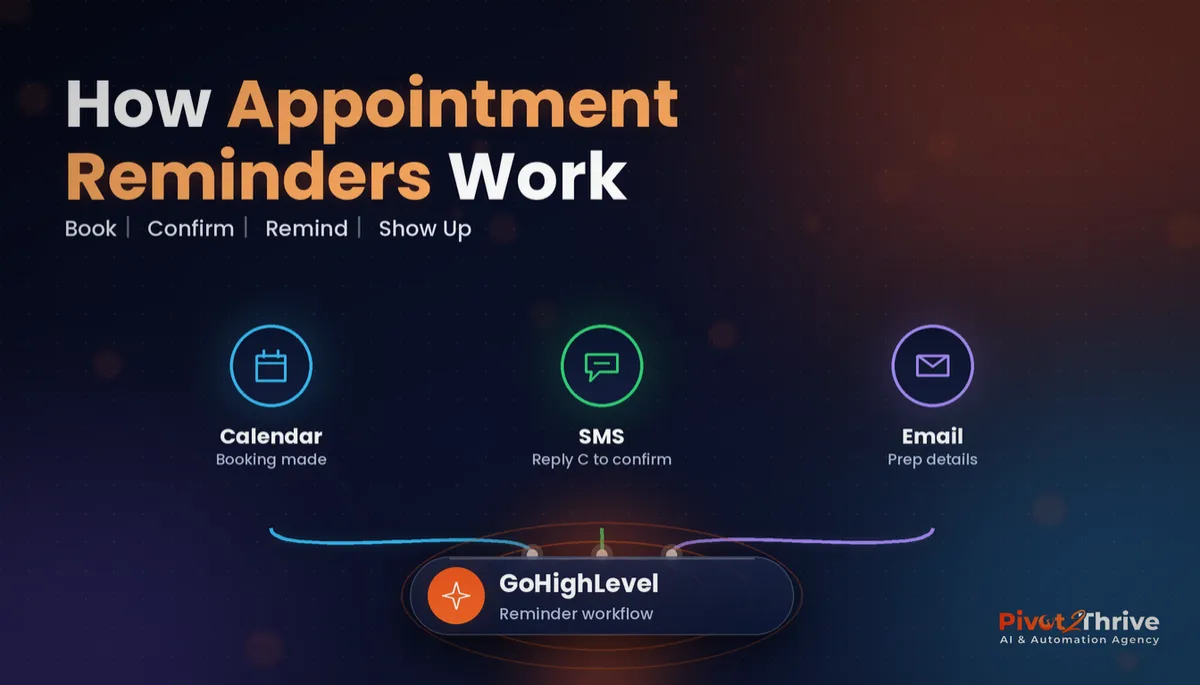 GoHighLevel Appointment Reminders: Cut No-Shows
Everything else