

AI Agency Late Payments: How I Would Get Paid on Time Without Chasing Clients (2026 Australian Guide)
Last updated: November 2026.
 By Dr Priya Jaganathan, Certified AI Tech Stack Consultant · Pivot 2 Thrive · Updated 8 November 2026 · 8 min read
The exact system I would use to stop AI agency clients paying late: terms that hold, automatic reminders, card-on-file retainers and a calm escalation path that keeps the relationship.
AI agency late payments are the cash-flow problem nobody warns you about when you start. You deliver the voice agent, the workflows run beautifully, and then the invoice sits unpaid for three weeks while you cover software bills and contractor wages out of your own pocket.
Some links below are affiliate links — if you sign up through them, Pivot 2 Thrive may earn a commission at no extra cost to you. It never changes what we recommend.
To stop late payments, an Australian AI agency should agree payment terms before work starts, bill retainers in advance by card or direct debit, automate friendly reminders before and after the due date, and pause non-essential work at a clear, pre-agreed point. Automation does the chasing so you never have to sound annoyed.
I'm Dr Priya Jaganathan — Go High Level Certified Admin, Certified AI Tech Stack Consultant and keynote speaker. At Pivot 2 Thrive I build these systems for Australian businesses every week, so this guide is written from the build, not the brochure.
AI agency late payments are a systems problem, not a client problem
AI agency late payments are invoices for builds, retainers or usage that clients settle after the agreed due date, or not at all without being chased.
Most late payers are not bad clients. They are busy owners with no reason to prioritise your invoice: it arrived by email, it had vague terms, and nothing happened when it went overdue.
That is good news, because a system fixes it. The same discipline that keeps clients renewing, which we cover in our guide to AI agency retainer renewals, also keeps them paying on time.
Why late payments hit AI agencies harder than most
Late payment is still normal in Australia. Xero Small Business Insights found that in the December quarter of 2025, small businesses waited an average of 23.9 days to be paid, with invoices still arriving about 6.6 days late, even though that was one of the fastest results since the series began in 2017.
AI agencies feel it more because our costs are upfront and recurring. Platform subscriptions, phone numbers, AI usage and contractor hours are paid every month whether the client has paid or not.
And the timing is about to get harder. December and January are slow months for many Australian clients, as our January slow season guide explains, so an invoice that slips in December can easily become a February problem.
How I would stop late payments in 7 steps
This works for solo operators and small teams alike. You can set up most of it in one afternoon inside your CRM and accounting software.
1. Put payment terms in the contract, not just the invoice. State the due date, the payment method, what happens at 7 and 14 days overdue, and that work pauses past a set point. Our guide to AI agency contracts and SLAs shows where this clause belongs.
2. Take a deposit before any build starts. I would ask for 50% upfront on setup projects, and never start configuring a voice agent or workflow until it clears. A deposit is the single best predictor of a client who pays the rest.
3. Bill retainers in advance, on autopay. Monthly retainers should be charged on the first of the month for that month, by card or direct debit, not invoiced in arrears. Clients rarely object when it is set up at onboarding.
| Billing approach | Cash-flow risk | Admin effort | Best for |
|---|---|---|---|
| Invoice in arrears, bank transfer | High | High (manual chasing) | Avoid where possible |
| Invoice in advance, 7-day terms | Medium | Medium | Setup milestones, one-off projects |
| Card or direct debit on autopay | Low | Low | Monthly retainers and usage fees |
| Deposit plus milestone payments | Low | Medium | Larger builds over several weeks |
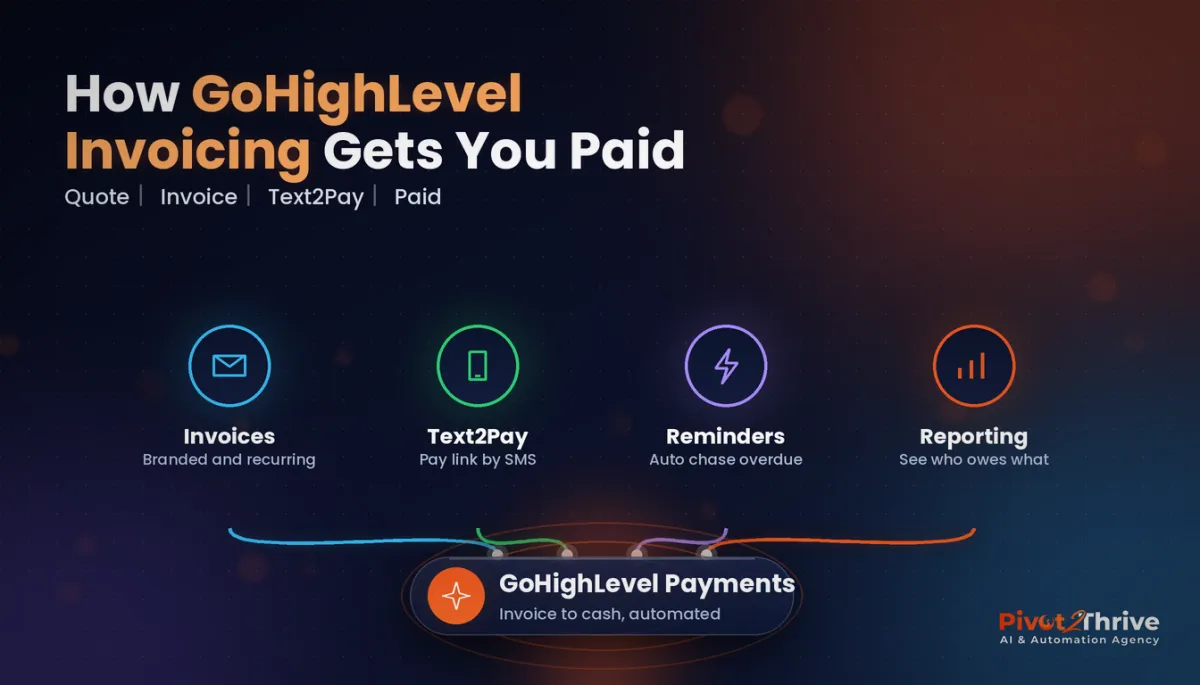
4. Send invoices with a pay-now link. Use HighLevel's invoicing or your accounting software so every invoice carries a card payment link and arrives by SMS and email. Our GoHighLevel invoices and text-to-pay guide walks through the set-up.
5. Automate the reminder sequence. A friendly note three days before the due date, a reminder on the day, then at 3, 7 and 14 days overdue. Each message is short, polite and includes the payment link. The automation does the chasing, so your relationship stays warm.
6. Escalate calmly at a pre-agreed point. At 14 days overdue I would call the client personally, not email. At 21 days, pause non-essential work such as new builds and reporting, while keeping anything their customers rely on, like an after-hours receptionist, running for a short grace period.
7. Track payment behaviour as a client health signal. A client who starts paying late is often a client who is about to cancel. Add "days late" to your client health score and treat a change as a reason to check in.
If you have to send a "just following up" email, your system has already failed. Let the automation be the bad cop so you can stay the trusted adviser.
Not on HighLevel yet? Start with a free 30-day trial — enough time to build everything in this guide before you pay a cent.
An Australian example: a two-person agency in Adelaide
Here is an illustrative scenario. A two-person AI agency in Adelaide looks after twelve local service businesses on monthly retainers, all invoiced at the end of each month by bank transfer.
Every month, three or four invoices ran late. The founder spent Friday afternoons writing awkward follow-up emails and twice paid contractors from a personal credit card.
They moved every retainer to card autopay at renewal time, added a deposit to new builds and set up an automated reminder sequence in their CRM. A "payment overdue" stage in their pipeline now alerts the founder at 14 days.
The result they notice most is not the money, though that arrives on time. It is that Friday afternoons are for sales again.
Late payment mistakes AI agencies make
- Starting work before the deposit clears. Once the build is live, you have nothing left to hold back. Wait for the money.
- Invoicing retainers in arrears. You are lending clients a month of your work. Bill in advance.
- Chasing by feel. Ad-hoc reminders feel personal and awkward. A fixed, automated schedule feels professional.
- Switching off everything at once. Cutting a client's AI receptionist without warning hurts their customers and your reputation. Pause new work first, with written notice.
- Ignoring the pattern. A new late payer is often a churn risk. Ask what's changed before you send the next reminder.
If a client still won't pay, it may be time to part ways professionally; the same written process you'd use for retainer renewals applies.
Frequently Asked Questions
What payment terms should an AI agency use in Australia?
Most Australian AI agencies do well with a 50% deposit on setup builds, the balance on go-live, and monthly retainers charged in advance by card or direct debit. Invoice terms of seven days suit one-off work, and the terms should be in the signed agreement, not just on the invoice.
How do I chase a late invoice without damaging the relationship?
Use a fixed, automated reminder schedule with short, friendly messages and a payment link, so chasing never feels personal. Make a personal phone call only at a pre-agreed point, such as 14 days overdue, and ask if anything has changed in their business.
Can I pause an AI agency client's services for non-payment?
You can if your contract allows it and you give written notice first. Pause new work and reporting before anything customer-facing, and give a short grace period on services like AI receptionists so the client's own customers are not affected.
Should AI agencies charge late fees?
A late fee can work if it is clearly stated in the signed agreement and applied consistently, but many agencies find autopay and deposits prevent the problem more effectively. Get advice before charging fees or interest, as the terms must be reasonable and agreed in advance.
How can GoHighLevel help with late payments?
GoHighLevel can send invoices with a card payment link by SMS and email, run automated reminder workflows before and after the due date, and move overdue clients into a pipeline stage that alerts you. Combined with saved cards for recurring retainers, it removes most manual chasing.
How common are late payments for Australian small businesses?
Late payment remains common: Xero Small Business Insights reported that in the December quarter of 2025, Australian small businesses were paid in 23.9 days on average and about 6.6 days late. That was one of the better results since 2017, so building a payment system is still worthwhile.
Still deciding on a platform? Try HighLevel free for 30 days and set up your invoice reminder workflow first.
Related Articles
Our services
- PowerPivot Leads Pro — AI lead generation and follow-up
- AI Receptionist Agent — answer every call, 24/7
Keep reading
 GoHighLevel Invoices and Text-to-Pay Setup
 AI Agency Contracts and SLAs in Australia
 AI Agency Client Health Score: Spot At-Risk Clients Before They Cancel
 GoHighLevel Webhooks: Connect Your CRM to Your Other Apps
Everything else